

This is the second part of a Ramadan reflection. Read the first part here.
Day eight. I woke up this morning and the thought was already there before my feet hit the floor: where is the barakah?
I am exhausted. And not in a way I am used to. This year, the smallest things leave me utterly drained—a short errand before Maghrib (sunset prayer), a few tasks around the house, the simplest responsibilities that should not cost this much effort. I have started saving my Quran reading for after Isha (night prayer), when I am fresher, because during the day I cannot give it what it deserves. This is new for me. I do not remember Ramadan feeling this heavy before.
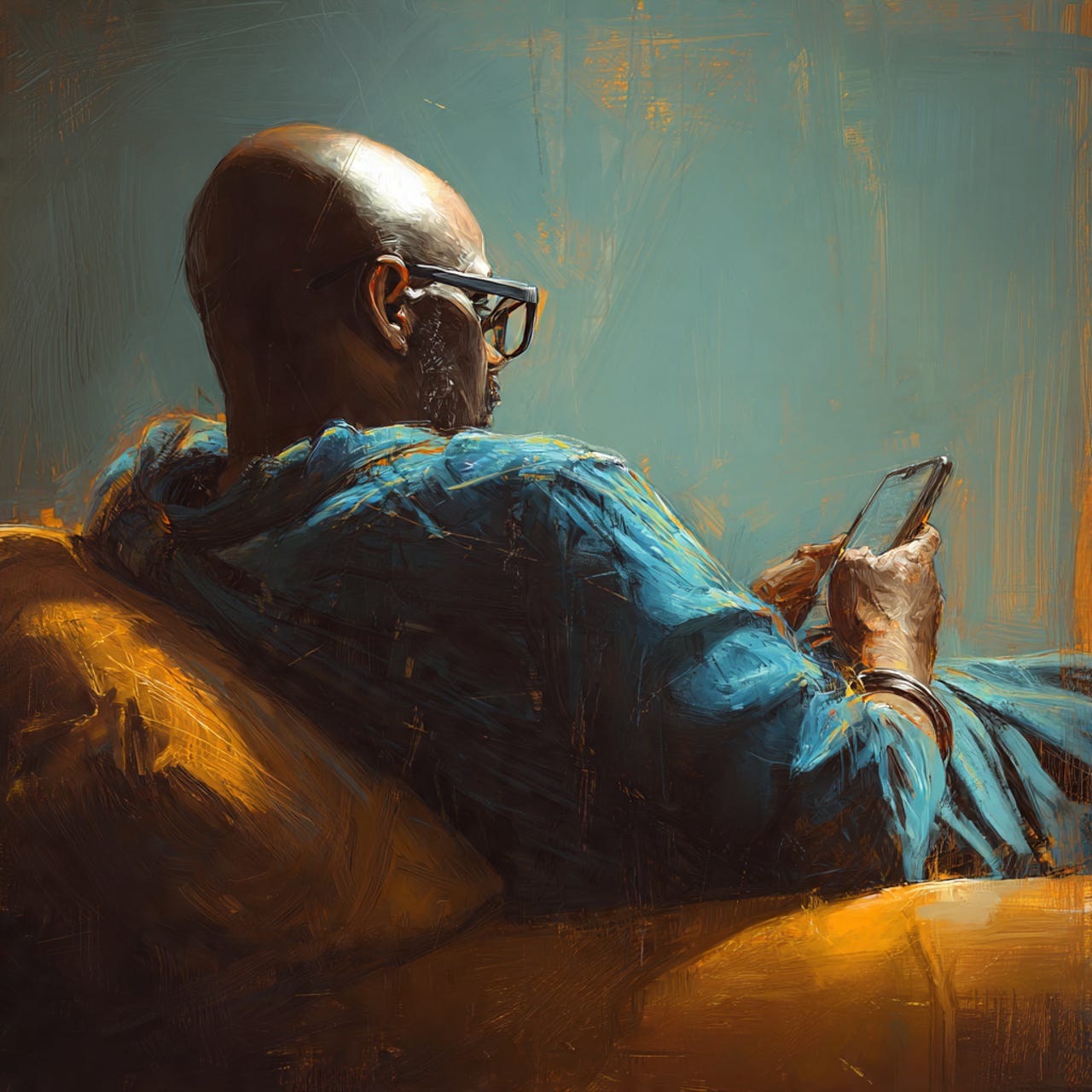
Last night, after iftar (the fast-breaking evening meal), I caught myself scrolling through my phone for over an hour. Not reading anything. Not learning anything. Not serving anyone. Just lost in the algorithm, swiping from one video to the next, letting the screen fill the space where something more intentional should have been. The worst part was that I barely noticed until it was over—until I looked up and realized an hour of a Ramadan night had passed through my fingers and I had nothing to show for it. Not a single dua (supplication). Not a single page of Quran. Just the dull glow of a screen and the faint shame that follows.
And Ramadan, I keep reminding myself, does not happen in a silo. Life did not pause because the month began. The same problems I carried into Ramadan are still here—work still presses, bills still sit in the inbox, a difficult conversation I have been avoiding did not resolve itself just because I started fasting. I am carrying all of it, and now I am carrying it on an empty stomach.
I expected by now to feel something shifting. Some sign that the month was working on me, that the sacrifice of hunger and thirst and broken sleep was producing something I could point to and say: there—that is what this is for. Instead, I just do not have the energy to do anything. And beyond the exhaustion, there is something else I did not expect: I do not feel the specialness. The festivity. That particular Ramadan feeling I have always associated with the month—the communal warmth, the anticipation, the sense that something sacred is happening and I am inside of it. This year, it is not there. And I think part of it is that my Ramadan is differentit I am at home with my family, not at the masjid (mosque) the way I have been in years past. The rhythm is different. The energy is different. And without that external atmosphere, I am left with just myself and my fast—and the silence between us is louder than I anticipated.
So the question sits with me. It has been sitting with me for days, if I am honest, but this morning it finally surfaced clearly enough to name: where is the barakah I was promised?
I have been thinking about what it actually means when I say barakah.
My whole life I have heard it. Ramadan is the month of barakah (blessing). The rewards are multiplied. The gates of Jannah (Paradise) are open. The shayateen (devils) are chained. Somewhere in the final stretch there is a night worth more than a thousand months. I grew up hearing these things repeated every year, and I absorbed them the way I absorb anything I hear often enough—without ever stopping to ask what they actually require of me.
I think I built an assumption I never examined: that barakah is atmospheric. That it descends on the month the way weather descends on a city—I did not have to do anything to make it rain, I just had to be outside when it happened. I assumed that if I showed up to Ramadan—if I fasted, prayed, attended tarawih (night prayers), read some Quran—the barakah would do its work on me. That the month itself would carry me.
We talk about Ramadan like a spiritual charger. Plug yourself in, hold on, and the barakah will do the rest. Your iman (faith) is low? Ramadan will fix it. Your heart feels distant from Allah? Ramadan will soften it. You have been neglecting your worship for eleven months? Ramadan will make up the difference.
But what if that is not how it works?
The gates are open—but I still have to walk through them. The shayateen are chained—but my nafs (ego, the self that inclines toward its own desires) is not. And that is the part no one warns you about. When the external enemy is removed, the internal one gets louder. The nafs does not need Shaytan (the Devil) to operate. It knows my patterns. It has been studying me my entire life. It whispers in my own voice, which is why I so rarely recognize it as something separate from myself.
Part of me wants to extend grace to the version of myself who scrolled for an hour or drifted through tarawih without presence. And part of me knows that grace without honesty is just permission. I was tired, and that is true. But tired is not the same as powerless. I had an hour of a Ramadan night and I handed it to an algorithm—not because I had no choice, but because the intentional thing felt harder than the mindless thing. That is worth sitting with, not explaining away.
There is a hadith that keeps pulling me back this week. The Prophet ﷺ said: “Whoever does not give up false speech and acting upon it, Allah has no need of his giving up his food and drink.”1
I have heard this hadith every Ramadan for as long as I can remember. It was usually delivered as a warning—behave yourself while you fast; do not lie, do not backbite, do not let your tongue undo what your stomach is trying to build. But sitting with it this week, in this particular state of fatigue and questioning, it reads as something else entirely. It reads as a diagnosis. Allah is not saying He does not want my fast. He is saying the fast was never about the hunger. The hunger is a tool. And if the tool is not being used to build something—if I am enduring the physical deprivation without letting it reach anything deeper—then it is just suffering without a harvest. Allah has no need of that. Not because He is rejecting me, but because He designed the fast to do something far more than make me hungry, and I have been stopping at the surface.
This is where the barakah question begins to answer itself.
Barakah is not a feeling. It is not a vibe the month generates. It is the fruit of what I pour into the vessel. The restraint of the tongue when it wants to complain. The lowering of the eyes when they want to consume. The softening of the heart when it wants to harden against someone who hurt me. These are not passive experiences. They are offerings—and barakah grows in proportion to what is actually offered.
An empty fast—one where the body is hungry but the tongue is still careless, the eyes are still scrolling, the heart is still cluttered with the same grievances and anxieties it carried in—produces empty barakah. Not because Allah withheld it, but because there was nothing for it to grow in. You cannot plant seeds in concrete and blame the rain for not coming.
Imam Al-Ghazali (d. 505/1111), in his Ihya ‘Ulum al-Din, describes three levels of fasting: the fasting of the common people, which is abstaining from food and drink; the fasting of the select, which is guarding every limb from sin; and the fasting of the elite of the elite, which is the fasting of the heart from everything that is not Allah.2 I used to read that and think it was aspirational—a framework for saints, not for someone like me. But I am starting to wonder if what Imam Al-Ghazali is describing is not a hierarchy of achievement but a hierarchy of depth. The first level is where you begin. The second is where the fast starts to reach your limbs. The third is where it reaches your interior—the hidden places I perform from, the self-image I protect, the version of myself I curate even in worship.
Shaykh Abdul-Qadir al-Jilani (d. 561/1166) takes it even further. He describes what he calls the fast of truth—preventing the heart from worshiping anything other than the Essence of Allah, “performed by rendering the eye of the heart blind to all that exists, even in the secret realms outside of this world, except the love of Allah.”3
That phrase—rendering the eye of the heart blind—has stayed with me. Because the things cluttering my Ramadan are not only the obvious distractions. They are the subtle ones too: the self-image I bring to worship, the expectation of how transformation is supposed to feel, the curated version of devotion I have been performing even when no one is watching.
I keep thinking about that—the performance I carry into my ibadah (worship). In years past, at the masjid, there was always an audience. Not one I was consciously playing to, but one that was there. The congregation saw me pray. The community saw me serve. There were people to greet after tarawih, people who knew I was there, people whose presence made it easier to show up and feel like I was doing Ramadan well. This year, at home, no one sees me except my family. There is no congregation to perform for, no public version of my worship to maintain. And what that absence is exposing is unsettling: how much of what I thought was devotion may have been sustained by being seen. How much easier it was to feel spiritual when the environment carried me. This year, with the audience removed, I am finding out where the real work is—and it is in the places no one else was ever looking.
The rewards are multiplied. But what is being multiplied if the offering itself is hollow?
I think I have been waiting for Ramadan to transform me. And the silence I am feeling—this absence where the barakah should be—is not a sign that Allah has withheld something. It is Ramadan asking me, quietly and without judgment, what I have actually brought to it.
The month is not over.
And maybe everything up to this point—the fatigue, the emptiness, the restless questioning that woke me up on day eight—has been the fast doing exactly what it was designed to do. Stripping away my assumptions. Dismantling the performance. Leaving me with nothing but the real question: what is actually between Allah and me right now?
The depletion is not failure. It may be the most honest I have been all month.
But I want to sit in that honesty for a moment before I rush to make it beautiful. Because the truth is uncomfortable. Surrendering to Ramadan—actually surrendering, not just enduring—means admitting something I have been avoiding: I have been showing up to this month on my own terms. My schedule of worship. My expectations of what transformation should feel like. My metrics for whether it is working. Surrender means releasing all of that—every self-imposed benchmark, every curated image of the devoted worshiper—and standing before Allah with the only thing I actually have: the truth of where I am.
That is a frightening place to pray from. It is also, I am learning, the only place where anything real begins.
And the nights ahead are not ordinary nights. Among them is Laylat al-Qadr (the Night of Decree)—a single night the Quran describes as better than a thousand months.4
A thousand months. That is not a reward designed for the strong. That is a mercy designed for the one who arrives at the last stretch with nothing left to offer but themselves. The one whose barakah did not come on schedule, whose Ramadan did not follow the arc they imagined, who is standing at the threshold of these final nights and wondering if it is too late.
It is not too late. That is the whole point.
Laylat al-Qadr is Allah’s answer to every person who reaches the end of the month still searching. The barakah I was looking for was never going to arrive on my timetable. It was always waiting here—in a single night, offered to the one still humble enough to be looking.
Maybe that is what real barakah has been all along. Not the spiritual high I was expecting. Not the feeling of closeness I thought would arrive on cue. But the slow, quiet breaking open that forced me to stop pretending and start seeking. The fast beneath the fast—the one that reaches past the stomach and into the places I have been avoiding to look at, though Allah never has.
I do not need to recover what I think I have lost. I need to bring whatever I have left—honestly, without performance, without the curated version of myself—and trust that Allah meets that.
Allah does not need my hunger. But He is offering me, through that hunger, a door I almost missed because I was too busy waiting for the month to carry me through it.
I do not know what is on the other side of that door. But I know who put it there. And with Him (i.e., God) is all success.
Abu Hamid al-Ghazali, Ihya ‘Ulum al-Din (Beirut: Dar al-Ma’rifa), vol. 1, p. 234.
ʿAbd al-Qādir al-Jīlānī, The Secret of Secrets, trans. Tosun Bayrak al-Jerrahi (Cambridge: Islamic Texts Society, 1992), 83.
Quran 97:3.
Subhannallah, I was doing well this Ramadan but for some reason this morning I woke with a sadness... And then your post popped up...the headlines grabbed my attention and I realized I was not alone. Thanks for sharing your struggles along your journey as it helps others on their own journey.
barakAllah feek, and everything you said here is another proof that Allah is truly AlLateef subhanAllah.