

In the last post, “It isn’t my money,” I tried reflecting on how quickly a room can reorganize around a single currency—and how quickly our hearts begin doing invisible math about who matters, who has access, who feels “above.” I called those rankings imaginary ladders, not because they’re harmless, but because they often live inside us long before anyone says anything out loud. This piece continues that unease. Only here, the currency isn’t wealth—it’s proximity.
London, 2019
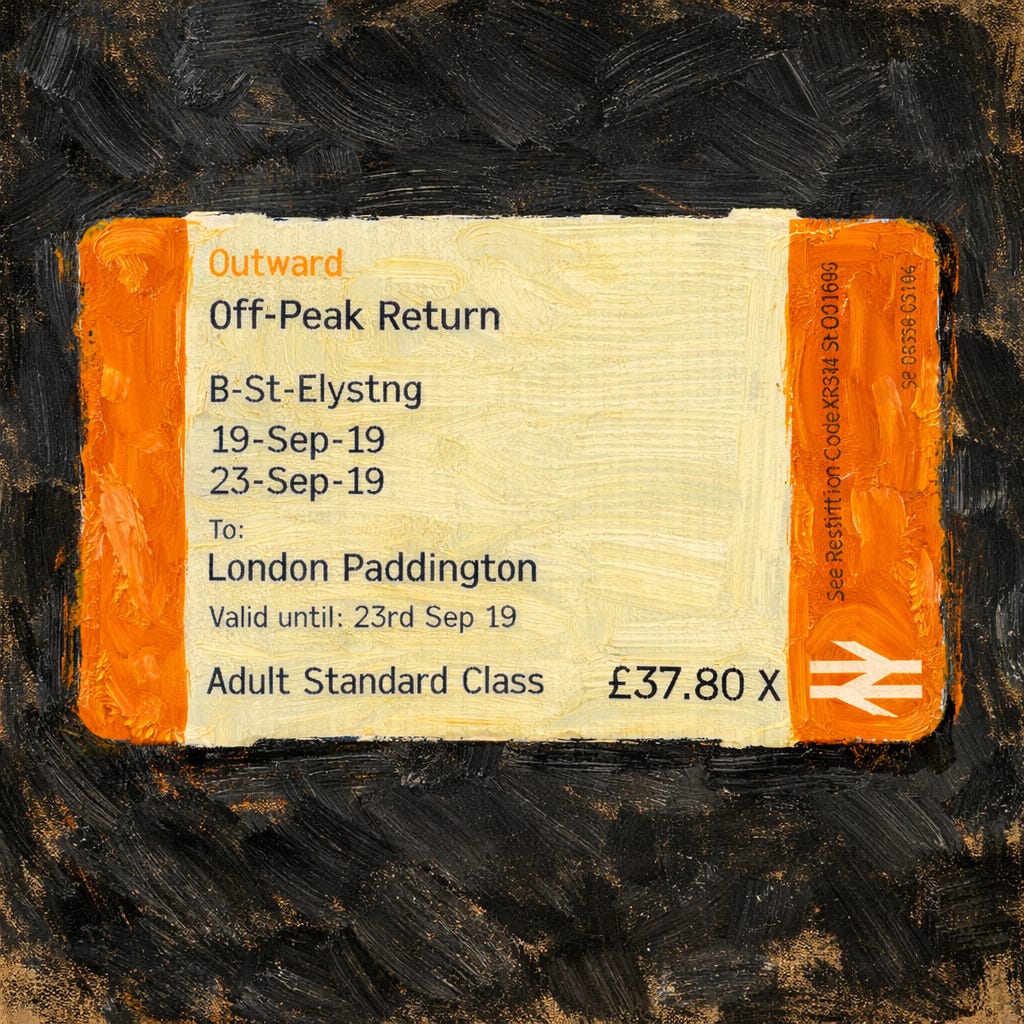
In 2019, on my way to London, I remember feeling full of excitement. The kind of excitement one feels in anticipation of being with loved ones. I was going to meet one of my teachers and some of his students. For years we communicated on WhatsApp and in Zoom meetings, watching livestreamed lessons and recorded videos, but this was the first time we were meeting in person. In my mind, that meant something—some unspoken merit attached to the shared affiliation, some uniting force that made being together feel spiritually beneficial even before anything happened.
Knowing this was a momentous occasion for me, Mustafa Davis graciously flew from Turkey to meet me there to help facilitate things and protect me from my own naiveté. In conversation, I told him about my excitement, the way we mention ordinary things in passing, assuming they don’t need to be examined. He didn’t let it pass. After a series of interrogating questions, he told me, plainly, that we should not treat the Shaykh’s students any differently than we would treat any other Muslim.
It would be easy to pretend that sentence was simply about manners, like a reminder not to be awkward in front of “important” people. But it wasn’t that. It was sharper than etiquette and kinder than embarrassment. It pointed directly at the place where sincerity can quietly tilt: the heart’s tendency to prioritize, to sort, to create categories of people who deserve a different kind of attention.

What stayed with me wasn’t only the correction—it was what it revealed about what I had already started doing inwardly. I wasn’t planning to disrespect anyone. I wasn’t thinking of myself as better. I was simply assuming that closeness to the Shaykh created a kind of spiritual gravity, and that gravity justified a different type of warmth. The risk wasn’t that I’d be rude to the Shaykh’s students. The risk was that I would be less present with everyone else.
There is a form of hierarchy that doesn’t announce itself in speech. It enters through the eyes and settles in the heart. We don’t say “these people matter more,” but we behave as if the room has tiers. We soften our voice for some and keep it dry for others. We listen more carefully when the person in front of us feels connected to what we want. We make a private exception in the heart, and then we convince ourselves it is reverence.
What Mustafa’s sentence did was expose how easily we can confuse reverence with preference. Reverence in Islam has a moral clarity: it honors knowledge, age, service, dignity, and the rights people hold. Preference is something else. Preference is when the heart begins to treat affiliation as proof. It is when we start to believe that being “close” to a sacred source makes someone more worthy of our warmth than the Muslim in front of us, who we assume is merely trying to stay afloat.
That moment in London didn’t ruin anything for me. It didn’t make me less grateful for teachers or less eager for companionship. It did something more honest: it made me wary of the part of us that turns good longing into a quiet ranking system. It made me suspicious of how my heart reaches for certainty in places never meant to carry that kind of weight.
Reflection: When we feel drawn to a circle that feels “sacred,” what do we quietly assume that closeness means—and who becomes ordinary in our eyes because of it?
Proximity Changes The Air
What makes this difficult to name is that it doesn’t begin with ugliness. It begins with love. We want to be near people who remind us of Allah. We want to learn. We want companionship that protects us from our own forgetfulness. These are good instincts. But the heart doesn’t only love what is good. It also loves what feels like security, and it can quietly fuse the two together.
There are forms of closeness that don’t simply feel like opportunity; they feel like reassurance. Being known starts to resemble being safe. Being invited starts to resemble being chosen. A place in the room begins to carry more meaning than it should. That is the moment something shifts, even if nothing outward changes. The space is still sacred. The people are still sincere. But an inward economy begins—small and mostly invisible—where access becomes a kind of currency we spend our attention to acquire.
We can sense it when we become more careful than we need to be. Not careful in the way adab (decorum) asks—careful in the way fear asks. We soften our opinions before we even speak them. We adjust our posture, our humor, our tone, trying to become the kind of person the circle will keep. Even our service can develop a calculating edge, as if the heart is quietly asking whether what we’re doing will bring us closer to what we want.
That’s what makes it spiritually dangerous: it can look like devotion. It can even feel like devotion. But adab is different from performance in one central way. Adab doesn’t need to be witnessed to be real. It doesn’t inflate in the presence of “important” people and shrink in the presence of ordinary Muslims. When our gentleness and attentiveness become selective, we aren’t refining ourselves; we’re negotiating.
This is where the moral tension deepens, because the longing underneath can be genuine. Many of us aren’t being formed by an environment anymore. We have fragments—messages, short visits, occasional gatherings—and then long stretches where no one sees our inner life. In that kind of landscape, closeness starts to feel like oxygen. It’s not only that we want benefit. We want something stable. We want a place where our hearts can stop improvising.
The tragedy is that stability can become something we chase through proximity itself. The moment that happens, closeness becomes proof, and proof becomes pressure. We begin to read normal human limits—time, boundaries, capacity—as personal verdicts. We start to interpret a closed door as rejection, a delayed reply as demotion, and we begin the quiet work of becoming smaller versions of ourselves in the hope that the room will hold us.
Reflection: If proximity starts to feel like proof, what are we tempted to do to secure it—and what parts of sincerity quietly get traded along the way?
Proximity ≠ Piety
In another post, I explored how Iman (faith) does not equal feeling. Warmth is not a reliable proof, and dryness is not a reliable defeat. What carries us is what settles in us and what we do with what we’ve been given. That correction protects us from thinking our emotional weather is a metric for Allah’s regard.
A similar correction belongs here: Proximity is not the same thing as piety. Closeness to a teacher can mean many things, and some of them are beautiful. But if we make closeness the measure of spiritual worth, we will spend our lives reading the unseen through the visible, and that reading rarely produces humility. It produces restlessness, comparison, and a constant need for signs because spirituality—a term somewhat foreign to classical Islamic scholarly tradition—has an inherently metaphysical component.
Religious communities become dangerous to the heart when we turn them into scoreboards. The scoreboard is rarely explicit. It’s made of small observations and quiet interpretations: who is near, who is named, who receives time, who is remembered. We begin turning those observations into conclusions about who is “serious,” who is beloved, who matters. The heart counts even when the tongue refuses to confess it.
If we use a hospital metaphorically for a religious community, it helps disrupt the romance of proximity without mocking anyone’s longing. In a hospital, everyone is present because something needs healing. People don’t arrive to prove they are well. Everyone has a chart that isn’t ours. And the one closest to the doctor may not be the one with the healthiest body; sometimes they are the one with the most urgent case, the most complicated wound, and the heaviest work ahead. When we remember this, envy loses some of its certainty. It becomes harder to idealize someone else’s place without knowing what it costs them.
Closeness can also be pragmatic. Sometimes someone is near because they translate, coordinate, host, or handle logistics. Their position reflects function, not rank. Their nearness may reflect service rather than spiritual standing. This doesn’t diminish the closeness or the service; it simply frees us from treating every visible role as proof of holiness.
Even when someone’s closeness is both piety and prudence—when the person near the teacher is genuinely upright, and the decision to keep them close is also practical—we can still over-interpret what that closeness means. We assume proximity comes packaged with the Shaykh’s comprehension, as though the student carries the teacher’s depth in their pocket. But students remain students, and closeness doesn’t automatically bring a person into the full architecture of what a teacher understands. Sometimes the person closest may not even know the edges of their own ignorance, and sometimes we don’t see those edges either until we hand them something too heavy: a conflict, a crisis, an attempt at counsel that requires skill they were never trained to hold. And we can make a parallel mistake with our teachers, quietly expecting them to be scholars, counselors, and conflict‑resolvers all at once, then feeling bruised when their gift is guidance in one realm and not another. The path has always required more than one kind of skill; our hearts are the ones that keep wanting one face to become a guarantee.
Holding these realities makes room for another truth to stay intact: respect is not the same thing as ranking. We honor scholars. We honor teachers. Knowledge has rights. Elders have rights. But the moment our reverence expands for insiders and contracts for ordinary Muslims, we should become concerned. The baseline is still the baseline: we honor Muslims as Muslims. We don’t let affiliation dictate our warmth.
Even when we accept all of this, the ache of being outside remains. Sometimes exclusion genuinely hurts. Sometimes, not being invited, not being seen, or not being answered triggers something deeper than the moment itself. The heart begins to narrate: if we were more useful, more impressive, more loved, we’d be closer. That narration can quietly become entitlement. It tells us we deserve access because we’ve been sincere, because we’ve sacrificed, because we’ve waited.
Entitlement rarely arrives as arrogance. It arrives as wounded logic. It turns limits into humiliation, and absence into accusation. It makes us fragile, because it ties our steadiness to outcomes we don’t control. In that fragility, we can start bargaining again, reshaping ourselves again, hoping proximity will finally quiet the fear that we might be ordinary and still unheld.
Allah interrupts this entire reading of the world with a standard that refuses our social instincts: “Indeed, the most honored of you in the sight of Allah is the one with the most taqwa (God-consciousness).”² The verse doesn’t deny differences in circumstance or access. It simply denies our right to treat those differences as verdicts. It returns honor to something we cannot measure from the outside, and it forces our hearts back toward humility.
If taqwa is the measure, then proximity becomes what it always was: a means that can help, a burden that can test, a circumstance that can change. It can be a mercy and a trial. Either way, it isn’t proof. And if it isn’t proof, then the heart has an opportunity to become steadier—to keep walking without asking the room to certify our worth.
Reflection: When we’re not “inside,” do we still walk with the same steadiness—and what kind of guidance do we actually need to keep walking well?
A Baseline We Can Carry
What stayed with me from London wasn’t a new rule to recite. It was the sensation of being caught—gently, but unmistakably—right at the moment my heart starts making private exceptions. Not exceptions in an outward respect, but inward. The kind that feels like reverence until we notice who it quietly withholds itself from.
There’s a temptation, once we see that, to overcorrect into guardedness—to treat every circle as suspect and every longing as compromised. But sincerity isn’t numbness. It’s a slower honesty. It’s letting ourselves want benefit without turning that want into a ranking system. It’s remembering that adab doesn’t only live around people we admire. It lives in the ordinary, repetitive places where nobody is impressed by us.
Maybe that’s the deeper discomfort hidden inside the phrase “ordinary Muslims.” The term isn’t neutral. It’s a category our ego creates to make certain people feel like background—people who can’t give us access, who can’t improve our standing, who won’t place us closer to what we want. They become “ordinary” because we’ve decided they don’t change the story. And then we wonder why our hearts feel unwell in sacred spaces, while ignoring the place Allah may be training us most directly: in how we treat the ones we’re tempted to pass over.
It’s sobering to consider that part of our tarbiya (spiritual formation) might be this simple, and this costly: stepping outside our comfort zone—not only the comfort zone of familiar friends, but the comfort zone of proximity itself. The comfort of being near what feels spiritually “high,” near what carries status in our religious imaginations. Sometimes our tarbiya is found in getting physically closer to the center. Sometimes it’s in spending time with the overlooked and the unseen, and learning to lovingly serve without needing the scene to feel sacred first. Not as a performance of humility, and not as a project, but as a quiet return to the baseline Mustafa was protecting: warmth that isn’t selective, presence that isn’t strategic, reverence that doesn’t require a ladder.
If we’re honest, we might find that the most revealing question isn’t who we feel drawn to in the “sacred” room, but who we become capable of ignoring once we leave it—who we treat as interruption, who we treat as background, who we assume is merely trying to stay afloat. What would change in us if the people we’ve filed away as “ordinary” were the very place of our tarbiya and our closeness to Allah—where self‑righteousness can’t hide behind the atmosphere of sacred spaces, and nearness to Him is practiced through unglamorous tenderness, responsibility, and excellence?
Ultimately, with Allah is success.
Thanks for this - am writing on similar themes on my substack (http://asifmajidphd.substack.com/). Feel free to subscribe if it resonates