

Around Christmas last year, I was sitting next to one of my teachers at breakfast, complaining about how angry I was. I had recently resigned from ADAMS, but I did not actually want to leave. Allah had blessed me with more time with my family than ever before, but I was no longer part of a community. For nearly a decade, congregations had been a part of my family. I expected the grief of losing them. I did not know what to do with the anger.
My teacher listened, and then he said, gracefully, smiling, “Don’t worry.” I told him I was still angry. He said it again: “Don’t worry.” I pushed back a second time, and he offered a little more. “Perhaps this is better for you.” I pushed back a third time, because I did not want to be comforted. Finally, he said, “What you’re doing now, in your new work, is something you never would have been able to do at ADAMS.”
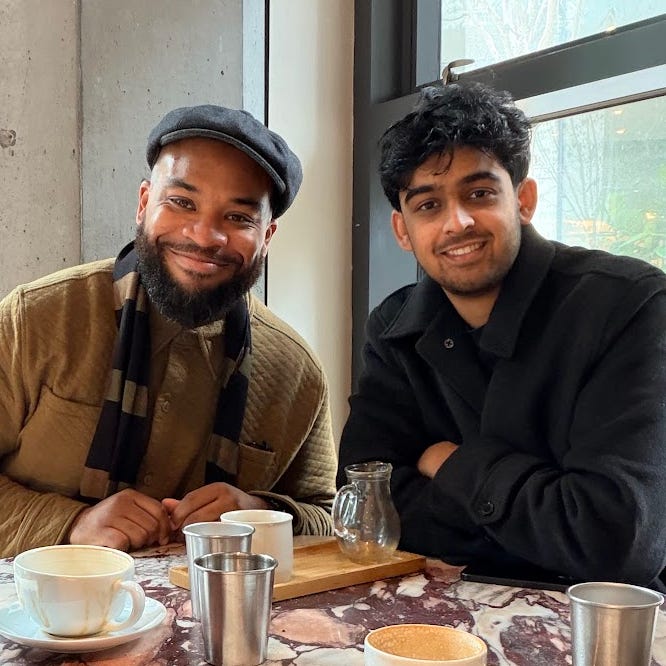
That evening at dinner, my teacher introduced me to Omar Waseem, a young man from the Bay Area who runs Alif, a venture fund for Muslim founders. He told me he wanted me to go to San Francisco and serve Alif. Nothing had happened between breakfast and dinner, and I had not been thinking about our conversation, so it caught me completely off guard. I was confused and a little lost—I had never been to San Francisco, it is a six-hour flight from home, and whatever this work was, it sounded like a kind of leadership I was not ready for. I tried to find my way out of it, and he would not let me. Omar, he said, seemed to be a good young man trying to steward something important, and we should help him.
My first trip out was a few weeks later. Omar told me I was attending a competition, and I later found out it was something called a hackathon. It was not until the night before that some volunteers explained what a hackathon actually was.
During the hackathon, I found Omar and told him, “I am an Imam and a practical theology nerd, and I have zero context for how to engage with the contestants. Give me some way to connect with them.” He said, “Just ask them where they’re from and what they’re building.” It was all I needed. I walked the room with those two questions and ended up giving feedback and advice to many of the contestants on their projects.
I kept going back in the months that followed, and somewhere along the way I came to love him. I have carried his two questions with me since. Where are you from? What are you building?

When Omar published his manifesto, I read it the way an older brother reads anything his younger brother puts his name to, hoping it would be good. It was. He ended with a question, “The world is changing hands. What will we do with what has been placed in ours?” I felt hope reading it, for him and for all of you who have gathered around what he is building. Alif already carries real weight among Muslim builders, and when someone with that kind of following stands up in public and says what the work is for, it shapes how a great many people understand their own. So I am writing in public too, to every builder who has found a home at Alif and everywhere.
What the Prophet ﷺ Prayed For
The Prophet ﷺ once prayed, “O Allah, honor Islam through the most beloved of these two men to You: Abu Jahl or Umar ibn Al-Khattab.” Notice whom he asked for. He named two men whose words carried weight in Makkah, men whose decisions changed what happened to other people. Umar was already strong, socially and politically, before he became Muslim. What made him Umar, radiya Allahu anhu (may Allah be pleased with him), was not his strength but the One he turned it toward. Your capacity to build, to raise money, to gather people, and to move things in the world did not begin with you. Allah gave it, so do not stop at recognizing where it came from. Turn it toward Him, the way Umar did. Let Him be the One you build for, the One you measure your intentions against, and the reason behind everything you do with what He has placed in your hands.
That changes what you are allowed to want. If the Prophet ﷺ asked Allah for strength turned toward Him, then wealth is too small a thing to aim at. So is status. Those are means, and some of you will have a great deal of them. The danger is not that you will have too much ambition. It is that you will spend it on something beneath you, and that money, or even success, which was only ever meant to carry you back to Him, becomes the place you stop.
Who Walks With You
When I was twenty-one and studying in Makkah, I made the major decisions of my life without asking anyone. When I finally found mentors, I wasted years because I did not know how to benefit from them. I have written about that elsewhere. I mention it because many of you are that age now, making decisions far larger than mine were, and I want to save you from losing those same years.
Shaykh Yasir Fahmy often says that everyone needs a mentor matrix comprised of a teacher, a wise elder, and an experienced friend. Startups have no shortage of mentorship, but much of it is transactional: advisors with equity, office hours, and investors who check in each quarter. There is nothing wrong with any of that, and none of it replaces the people who love you enough to disappoint you. Most of all, look for a spiritual teacher, someone rooted in the tradition and formed by teachers of their own, who cares for your soul, your relationship with Allah, and the question of what your life is ultimately for. Your investors will ask how the company is doing. You need someone who will ask how you are doing before Allah, and whose approval you cannot buy with anything you build.
Look also for an elder who has lived long enough to recognize the patterns you are about to repeat, and keep an experienced friend close, someone who has walked a stretch of road you have not. Do not chase the most famous name. The most sought-after people are often the hardest to reach, and a mentor you cannot reach cannot help you.
Then there are the people beside you on the road. Your world runs on relationships, and I don’t say that as a criticism. Introductions become investments, coffee becomes a cofounder, and the friend you made at a hackathon becomes your first hire. Much of what is good in this industry grew that way. The danger is quieter. When any relationship might become an opportunity, you begin, slowly and without noticing, to see people as what they might become for you.
The Companions knew this world better than we imagine. When the Muhajirun (Emigrants) arrived in Madinah with nothing, the Prophet ﷺ paired them in brotherhood with the Ansar (Helpers). Abdul-Rahman ibn Awf, a merchant, was paired with Sa’d ibn Al-Rabi’, who offered him half of everything he owned. Abdul-Rahman prayed that Allah bless Sa’d in his family and his wealth, and asked only to be shown the way to the market.1 One gave without calculating, and the other declined to take what he could build himself. Both understood trade, and neither let it touch the brotherhood.
Keep some people in your life whose friendship is not built on business. Work may find its way into those relationships, and that is fine, but it should never be what they rest on. Pitching them, recruiting them, or asking them for introductions should never become the reason you call. Love them for who they are, be glad when they succeed in a way that costs you nothing, and cover them when they stumble. If you ever catch yourself calculating what a friend could do for your company, take it as the moment to do something for them that they can never repay.
The Prophet ﷺ said that among the seven whom Allah will shade on the day when there is no shade but His are two who love each other for His sake, who meet for that and part for that.2 That love asks nothing of the other person, because it was never for them alone. Find a few people like that, and keep them, even in the seasons when you are too busy to call.
More Than a Name
When you introduce yourself at a pitch or a conference, “Muslim founder” often comes before anything else, and there is nothing wrong with that. It is true, and for some of you it took courage to say it out loud in rooms where no one else would. But it is only the surface of where you come from. Underneath it is a religion to be practiced with the body, believed with the heart and mind, and perfected in the soul, carried to you through a chain of teachers that runs back to the Prophet ﷺ, and owed to a Lord to whom everything you build will return. The name came to you as an inheritance, and the religion beneath it remains an open invitation, extended to you as much as to anyone.
The Quran speaks to this with remarkable gentleness. When some of the Bedouins claimed faith, they were told to say instead that they had submitted, because faith had not yet entered their hearts, and they were promised that if they obeyed Allah and His Messenger, none of their deeds would be diminished.3 The commentators noticed that the word chosen for “not yet” carries an expectation that what is missing is still on its way. I take more comfort in that than I can easily say, because I have spent most of my life somewhere between the name I carry and the religion I am still growing into, and I do not expect to outgrow my need for that door.
Because the religion is more than a name, your work does not need to wear the label to carry it. In an interview on The Ansari Podcast, Omar put it this way: “It isn’t that we need to be the best Muslim podcast, or the best Muslim cafe, or the best Muslim founder. We just want to be Muslim, and then be the best to ever do it, in our category.” I agree with him completely. He makes a similar point in his manifesto: the people who live with the consequences of your work deserve more than good intentions. The Quran named that standard long ago, when one of the daughters of the old man of Madyan told her father that the best one to employ is the strong, the trustworthy.4 The religion asks for both, capability and trust, offered because Allah sees your work, whether or not anyone else does. The Prophet ﷺ was sent as a mercy to all the worlds,5 and work done with excellence for whoever it reaches is one of the plainest shapes that mercy can take. There is no shame in being visibly Muslim, and no one should ask you to hide it. But the label is not the achievement. Let your work be so good, and your dealings so honest, that people eventually ask what formed you.
Work like that is rarely made in public. Startup culture rewards building in public, and there is value in it, but do not confuse the performance of growth with growth itself. Most of what makes anyone great happens out of sight: years of repetition, work no one applauds, and roots that drink slowly where no one can see them. Ibn Ata’illah Al-Iskandari (d. 709/1310) said, “Bury your existence in the earth of obscurity, for whatever sprouts without first being buried does not come to full fruit.”6 The Prophet ﷺ said that the deeds most beloved to Allah are the most constant, even if they are small.7 Most greatness is exactly that: small, constant, unseen, and done for Him.
None of that holds unless something keeps you oriented. You know your runway to the month. Know the state of your prayer the same way. Five times a day, wherever the work has taken you, a qibla (direction of prayer) turns you back toward the same place. That turning is what keeps excellence from becoming its own idol, and it is how a builder remembers, in the middle of the most important week of the company, whose work this finally is.
Think It, Build It, Ship It, Tweak It
It was at Alif that I first heard those four words, and I remember thinking how much they sounded like something my teachers might have said. You know the cycle better than I do: figure out what to build and why, build something real enough for people to use, put it in their hands, and keep improving it. I won’t pretend to teach you your own craft. But each stage has a question the tradition has been asking for fourteen centuries, and I would like to ask them alongside yours.
Think It. Before what, ask why. Every action is weighed by its intention,8 and intentions drift as the work grows. The reason you started is rarely the reason you are still going three years later, so renew it often and honestly. Before a large decision, the tradition gives you two tools that most founders never use: istikhara (the prayer for guidance), which the Prophet ﷺ taught his Companions for every matter, the way he taught them a surah of the Quran,9 and shura(consultation) with people who will tell you the truth. The Quran puts the whole cycle into a single instruction: “consult them in the matter, and when you have decided, rely on Allah.”10 Ask, too, what the yes will cost. Every priority is a choice about what you serve, and the Prophet ﷺ said that no one’s feet will move on the Day of Judgment until they are asked about their life and how they spent it, and their youth and how they used it.11 Some of you are spending your youth on this. Make sure it is worth the price, and know what you are paying. I once tried to define maturity as the ability to think about the future, plan accordingly, and act appropriately despite the challenges you will inevitably face. By that definition, the cycle you already live by is a school of maturity, if you let it be one.
Build It. How you build is part of what you build. Ihsan (excellence) belongs in the code, and also in the means: in what you tell investors when the numbers are bad, in the corners you are tempted to cut when no one is looking, and in how you treat the people building it with you. The Prophet ﷺ described ihsan as worshipping Allah as though you see Him, knowing that even if you do not see Him, He sees you.12 That is the standard for the work no one else will ever check. He also said to give the worker their wage before their sweat dries.13 Early teams give a great deal on faith. Honor that, and never let the mission become an excuse for treating people as fuel.
Ship It. Here the product leaves your hands and enters other people’s lives, and it becomes an amanah (trust) toward them. What are you actually putting into their days? Does it serve their attention or exploit it? Would you be comfortable explaining to Allah how it made money? This is also the stage where success tends to arrive, and success has its own danger. Abdul-Rahman ibn Awf, the same merchant who once asked only to be shown the market, became one of the wealthiest of the Companions. Years later, while fasting, he was brought food and began to weep, remembering Companions who had died with barely enough cloth to cover them. He said he feared that the rewards for his good deeds had been hastened to him in this world, and he could not eat.14 He was one of the best of them, and success still frightened him. It should frighten us a little, too.
Tweak It. What are you measuring? Whatever you measure is what you will slowly come to want, so be careful that growth is not the only number you watch. Measure what the people you serve actually gain, and measure yourself by the sincerity of your effort rather than its outcome. Some of you will have to pivot, and some of what you build will fail. Nothing given sincerely in the process is wasted; it becomes the ground you stand on when you change direction. And ask who else needs tweaking. Umar ibn Al-Khattab told the believers to take account of themselves before they are taken to account.15 That is iteration turned inward: noticing where you have drifted, turning back, and trying again. The tradition calls the turning tawba (repentance), and it is open as often as you need it.
Then, having planned with everything you have, set the outcome down. I did not learn this from a book. I learned it the year I left a community I did not want to leave, and I am still learning it. Ibn Ata’illah also said, “Give yourself rest from managing your affairs. What Another has taken up on your behalf, do not take up yourself.”16 You are responsible for the means. The outcome was never yours to carry.
When you weigh a decision, a hire, a partnership, or a campaign, three questions may help. Whom does this visibly strengthen, only us or the people beyond us? Would we still do it if the fruit ripened under someone else’s name? And if no investor, partner, or reporter ever noticed our part in it, would we do it the same way, with the same excellence?
You have been asked what you are building more times than you can count. Ask it of yourself with these questions inside it. The cycle you live by never really ends, and neither does the believer’s. Intention, work, accounting, and return, again and again, for as long as you live.
Held in Trust
Just before Ramadan, Alif moved into a new space, and so many people came that it could not hold them. The team had to scramble to find somewhere else to host. By the twenty-seventh night I was there, and it was beautiful and warm, a room full of people who had come to break their fast and pray together. It was how it was supposed to be. Nobody in that room was being recruited for anything. They were simply being served.
The tradition calls what happened in that room khidma (service). It is different from generosity, which gives from above, and different from networking, which gives in order to receive. It is the posture of someone who knows that nothing they hold is finally theirs. Your intelligence, your access, the rooms you can walk into, the money that may come, and the platform some of you already have were given to you in trust, and even what you worked hard for came through means Allah provided. Omar goes further in his manifesto and names the very moment you were born into as an amanah too, and I think he is right. Khidma is what a trustee does with what was entrusted: spends it on the people it was meant for, often where no one will ever see.
Decide now what your wealth and your name are for, before they arrive. Wealth tends to make the decision for you if you wait. The Companion who understood this best was Abu Bakr Al-Siddiq. He was a successful merchant before Islam, and afterward he spent his wealth buying the freedom of people who were being tortured for their faith, Bilal among them, and financing the work of others. Many of the commentators read the closing verses of Surah Al-Layl as describing him: the one who gives his wealth to purify himself, owing no one a favor to be repaid, seeking only the Face of his Lord.17 His money built other people’s futures, and he never asked them to repay him. That is the posture I would ask of you: to be the support beneath other people’s work, and to count it as success when they flourish.
It also means holding the community you serve with an open hand. The people who gather around your work are not the whole of the community, and the community you are responsible for includes people who will never walk through your doors. Some of the good you do will travel further than you can follow, into a company you never funded or the life of someone you helped once and then lost touch with. Omar ends his manifesto hoping we will recognize that some of the work most worthy of our lives may begin in someone else’s imagination. Serving that work, and letting it go wherever it needs to go, belongs to the same service.
Some of you are doing more than building companies. You are gathering people, and your world even has a word for what you are building: an ecosystem. I have tried before to describe what a healthy community actually is: a sustainable ecosystem that gives people a sense of belonging and a shared desire to contribute and serve. Spaces, events, and programming matter, but they are means. If you measure a community by attendance and polish, you will slowly start competing for people instead of forming them. A customer who leaves costs you revenue. A person who leaves a community loses a place to belong, and the community loses them. So build room for repair, so people can disappoint one another and still return. And make room, deliberately and structurally, for elders and spiritual guides: a standing place in the community, not an invitation only when something breaks. The communities I have seen last always had someone whose work was to keep them spiritually anchored, and to keep their intentions aligned with the One they were building for.
Some of you feel the urgency of this moment acutely, the sense that the world is being remade in a few short years and that whatever you do not build now, someone else will. For many of you, Gaza sharpened it, when it became painfully clear how little your standing inside the world’s institutions let you change their decisions. I understand that feeling, and I don’t think it is wrong. The Prophet ﷺ took urgency more seriously than any of us, and then freed it from needing to see the fruit. He said that if the Hour is established and one of you has a sapling in hand, and is able to plant it before standing up, let them plant it.18 The one who plants it will never eat its fruit. There will be no shade from that tree and no harvest from it. They plant because planting is what a servant does, and because the earth, the tree, and the harvest all belong to Allah.
Build like that. Give everything you have to work you may never see finished, and let it be enough that He sees it.
For Whom
Where are you from? What are you building? Omar gave me those questions when I had nothing to say, and in this letter I have tried to give them back with everything my teachers gave me. There is a third question beneath them, the one the other two were always reaching toward: for whom? Answer that one honestly, and keep answering it as the work grows. I came to Alif angry and unsure what I had to offer, and my teacher kept telling me not to worry. He was right, and I am grateful to every one of you for showing me why.
Omar, I am proud of you. I am praying for you, and for every builder, wherever they are building.
O Allah, You have placed something important in the hands of the builders of this generation, and they are trying to steward it well. Make them among those through whom You honor this religion. Protect their hearts, make their intentions sincere, and their work excellent. Surround them with companions who love them for Your sake and teachers who will not let them lose their way. Give them provision that does not distract them from You, and when You give them wealth and a name, let them spend both in the service of others. Ameen!
Your brother,
Abdul-Malik
Quran 49:14.
Quran 28:26.
Quran 21:107.
Ibn Ata’illah Al-Iskandari, Al-Hikam, no. 11.
Quran 3:159.
Reported from Umar ibn Al-Khattab; cited by Al-Tirmidhi after hadith 2459
Ibn Ata’illah Al-Iskandari, Al-Hikam, no. 4.
Quran 92:17–21
Omar doing great work mashallah
Really beautifully written and read imam. Allahuma barik.