

This is the third part of an unintentional and unplanned Ramadan reflection. Read the first part here and the second part here.

This is my favorite verse in the Quran. I don’t say that casually—I have lived inside this verse. It has been a mantra for me, something I have told myself so many times that I know it the way I know my name. In moments when the ground beneath me was giving way, and I had nothing else, I had this. It saved my life once.
I brought it with me into this Ramadan the same way I always bring it—with longing, with trust, with the expectation that it would do what it has always done. But I am further into the month now. The first weeks did their work—the arrival without excitement, the stripping, the question of where the barakah (blessing) was hiding while I waited for it to appear in forms I had already decided it should take. I am past that. I am not resolved. I am not performing anymore either. I am in a quieter place, the kind of quiet that only comes after you have stopped pretending the noise was worship. I am just here, holding a verse I love, waiting for it to do what it has always done.
But underneath that trust was an assumption I had never examined. I kept expecting the provision to arrive in forms I could recognize—spiritual intensity, inner clarity, the closeness to Allah that Ramadan has brought me in other years. When it did not come in those forms, I named the absence. I sat with the discomfort of a holy month that felt more like it was taking from me than giving.
A Simple Suggestion
It came from my brother Mohamad Habehh, after a post-Tarawih program that had nothing to do with mentorship and nothing to do with men. We had just finished—people were filing out—and Mohamad gave me Salams, then suggested I start a mentorship program for Muslim men. He said it simply, without an agenda. I could hear the care for the community in his voice.
I have heard this before. People have told me some version of this for years. I have wanted to build it for years. When I was at ADAMS, I actually started one—came in ambitious, announced it, began putting the pieces together. But I had not planned sufficiently. The sessions remained consistent, and the young men showed up—eventually growing to a weekly twenty to thirty people, MashaAllah—but what I had envisioned as a structured mentorship program quietly evolved into something closer to a support group. It was doing good work. I do not want to diminish that. But it was doing the bare minimum I knew it could, and I did not have the architecture to push it further. Eventually, I stopped calling it a program in my own mind. I told myself the timing was not right. I am not sure I believed that even then.
When Mohamad said it, the fear did not feel new. It appeared the way it always does when someone names what I have been avoiding—familiar, already in the room before I notice it. The internal voice that says: You do not have the technical skills to build this. You do not know how to design a website. You do not know how to structure a curriculum at scale without a team. You already tried once, and it turned out to be less than what you planned. I have heard this voice so many times that I stopped recognizing it as fear. It sounds like realism to me. Like a sober assessment of my limitations. Like wisdom.
But underneath the practical assessment—and I have only recently become honest enough to see this—is something else. It is not just that I lack the technical skills. It is that I know what it feels like to commit to something and not be able to deliver. I had already lived that once at ADAMS. I watched a vision I believed in settle into something I could not push further because I did not have the means to push it. If I committed again—publicly, formally, with men counting on me to build something real—and I could not deliver again, I did not know how I would carry that. When I said I needed a team, when I called it collaboration, some of that was true. And some of it was the fear of standing before a commitment I could not fulfill. I dressed the avoidance up as wisdom, and it was convincing enough that I believed it myself.
This Ramadan—away from the masjid, away from the role I had carried for years, with more space than I am used to and less structure to fill it—Mohamad's words sat with me differently. I do not know why. They were the same words other people had said before. But something in me did not close the way it usually does. I did not say yes. I did not say no either. I just let them sit.
Eleven in the Morning to Eleven at Night
The next morning, I woke up from a nap with Mohamad's suggestion still lingering in my head. I did not sit down to build a program. I just picked up my phone to explore an idea. That is all. A sketch on a napkin. I had been using AI in the most basic ways—a search engine with better sentences. But that morning, I put the idea of a mentorship program into it the way you might think out loud to someone, not expecting it to go anywhere. Just curious. Just wondering if the thing I had been imagining for years had any shape to it beyond the shape in my head.
It did. And the shape came fast—sharper and clearer than I expected. The sketch showed me it was possible. That was the first crack. Not courage. Not some decision to finally act. Recognition. This is possible. It has been possible.
What followed was not something I planned. The exploration on my phone became an outline on my laptop. The outline became a curriculum—session by session, topic by topic, drawn from every conversation I have had over the years with young men who needed something I could only offer them informally. It had been waiting. The curriculum demanded a home. So, I started building it onto my consulting website—SuhbaConsulting.com—working out the pages, making it navigable, translating what lived in my mind into something another person could actually walk through. Not because I had planned to. Because the thing kept opening, and I followed it.
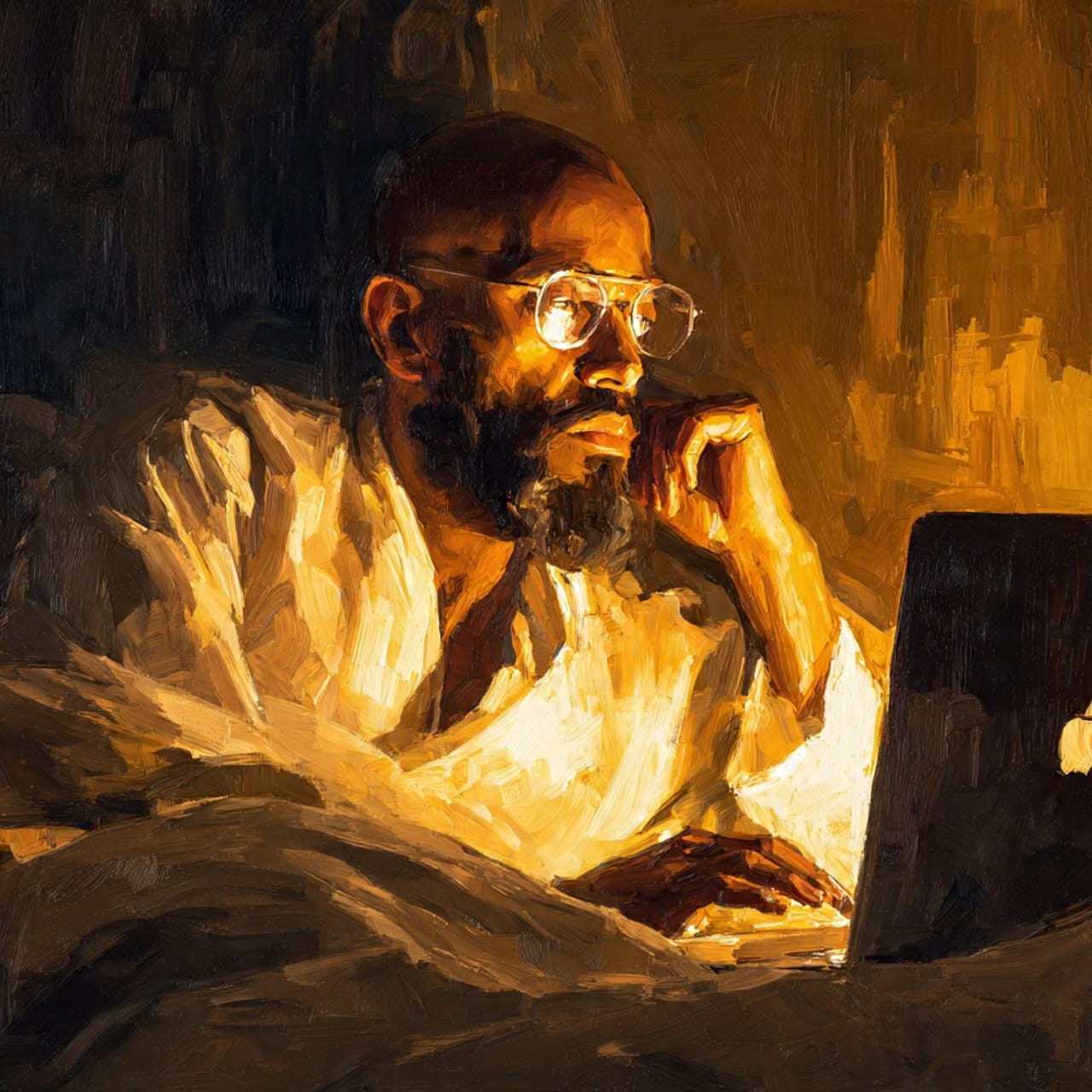
I only stopped for salah (prayer) and iftar (the fast-breaking evening meal) with my family. Eleven in the morning to eleven at night. I was not watching the clock, pacing myself, or deciding to keep going. I was just inside it. At some point in the evening, the house got quiet—the dishes from iftar were done, the kids went to bed—and I was sitting up in bed, the glow of the laptop the only light in the room, and I had not noticed any of it happening.
When I looked up, Rijal: Men’s Formation Community existed. The curriculum was complete. The website was built. It had taken a single Ramadan day.
I sat there, and the feeling was not triumph. It was more subtle than that. Disbelief first. Then a grief I was not prepared for—the kind that comes when you realize how many years you spent standing outside a door that was never locked. I will not dwell on that. The verse is not about what I missed. It is about what arrived. AI did not generate the vision. It gave me the structural and technical means to build what I already carried.
From Where You Never Expected
I am in Ramadan. The holiest month of the year. A month I entered without excitement but with longing. A month I spent asking where the barakah was, peeling away layers of performance, sitting with the hard question of what I had actually brought to the table. And the thing that cracked something open in me was not a verse I wept over in the last third of the night. It was not a moment in sujud (prostration) where I felt Allah's closeness wash over me. It was twelve hours at a laptop, building a program and a website.
I am aware of how that sounds.
I have asked myself the question more than once: Am I spiritualizing a productive day? Is this tawakkul (trust in Allah), or is it just the satisfaction of getting something done, dressed up in religious language because the calendar says Ramadan?
I have sat with that question. I think it deserves to be sat with.
The barakah that comes through tahajjud (late night prayer) and tears in prostration and the Quran softening the heart at three in the morning—that is real. That is provision too. I have tasted it in other years, and I know people who tasted it this Ramadan, and I do not want to diminish it or talk past it. That is a door many people walk through, and it is a real door, and Allah is on the other side of it. Perhaps for me, this Ramadan, provision also came through something I did not expect. Not instead of the traditional forms. Not as a replacement. Alongside them. And that distinction matters more than anything else in this paragraph.
Because the verse says min haythu la yahtasib—from where he never expected. I have been reciting those words my entire life, and I always read them as provision arriving from outside: an unexpected rescue, a door opening from the other side, help appearing from a direction I could not have predicted. That is how it has come before. That is how it saved my life.
But this Ramadan, the verse is teaching me something I missed. Sometimes “from where you never expected” means from inside yourself. From gifts He placed in you that you refused to use. From a calling you carried for years and kept at arm’s length because the execution scared you more than the idea ever did.
There’s a distinction I keep turning over, because it matters. “I had it in me all along” is a self-help conclusion. It places the credit with me, turns the story into one of unlocked potential, and makes it about finally believing in myself. That is not what happened. What happened is that Allah had placed it in me all along—the pastoral instinct, the study at Umm al-Qura, the years of training under numerous mentors, the counseling in Boston, the mentorship at ADAMS, and the thousands of hours sitting across from men who needed something I could feel but could not yet build. None of that was self-generated. It was all rizq (provision) from Him, deposited over decades into a man who kept treating his own deficiencies as the final word rather than as gaps He was already, quietly, filling. The beta program at ADAMS was not a failure. It was preparation I did not recognize as preparation. Every man who sat across from me needing something I did not yet have a structure to give him—that, too, was preparation.
I have taught the hadith (prophetic tradition) of the man and his camel dozens of times. A man came to the Prophet ﷺ and asked, “Should I tie my camel and trust in Allah, or should I leave it untied and trust in Allah?” The Prophet ﷺ replied, “Tie your camel, then trust in Allah.”1 I have quoted it in khutbahs (sermons). I have used it in counseling sessions. I have explained it to young men who were sitting right in front of me, needing exactly what it teaches.
I understood it. I had always understood it. But this Ramadan, it was no longer something I was teaching. It was something I was living.
Under any other circumstances, I would have been afraid. I know that about myself. If someone had told me to sit down and build a mentorship program, I would have shut down the way I always shut down. But that is not what happened. The opening came so gently that I did not recognize it as an opening. A sketch on a phone. A question I did not expect an answer to. And before I knew it, I was already inside it—building, following, trusting—not because I had decided to be brave, but because Allah had made the path so subtle that the fear never had time to arrive. The framework took shape in a single day. Now I have enough to keep filling it out over time.

Rijal exists now. It is real, and I am excited about it in a way I have not let myself be excited about something in a long time. It will be work. It will demand more of me than a single Ramadan day. But the hope—and I hold this hope carefully, because I have learned what it costs to hold it carelessly—is that men will sit in this program and be formed by it. That, over time, it builds the kind of transformative suhba (companionship) that my mentors and teachers gave me when they did not wait for perfect conditions before pouring into me.
I do not know where it goes from here. But I know who placed it here. And I know that the verse I have been reciting my entire life—the one I carried into this Ramadan expecting it to answer me the way it always has—answered me from where I never expected.
Ultimately, with Allah is all success.
first and foremost, may Allah bless you for what you've done. secondly, this speaks to me on multiple levels. I'm similarly feeling as if I'm not living up to the potential that I have. I imagine also working on a mentorship program in this case for new Muslims and I am also discovering the blessings that come from the clarity that can come from sharing your struggles with AI and the responses that can give you sometimes as you've mentioned, even from your own self from the conversations and the resources and everything that you've been engaging with and maybe not fully appreciating and drawing out things that you either forgot or never really discovered etc. so your whole article and your whole journey speaks volumes to me and the idea that the experience and Ramadan can show up in many different ways and the spiritual experiences are are real and no less valuable. but the important thing is that those spiritual experiences lead to the final destination which is becoming a better version of ourselves, and I think at its core that's what you're describing. that's what you're talking about. that's something that I definitely can feel because I'm having a similar struggle of similar journey and I look forward to seeing what Rijaal can become. I can hear the excitement in your strained and sickly voice and that's beautiful and I pray for all success for you. may Allaah bless you and I hope we get to meet someday soon
Salaam, I am a sister who's a big fan of your blog, and subhanAllah this couldn't have reached me at a better time. Such profound reflections that really resonated with me. This Ramadan feels different to me, it's silent, it's contemplative, and the first time I've found myself sitting with the discomfort instead of rushing to soothe it. Until recently, I found myself urgently looking for immediate answers, desperate to control the narrative, look for Allah's signs in everything, and wait for something to pull me out of my rumination and put me where I needed to be. I had to take a moment to sit with this:
"The opening came so gently that I did not recognize it as an opening. A sketch on a phone. A question I did not expect an answer to. And before I knew it, I was already inside it—building, following, trusting—not because I had decided to be brave, but because Allah had made the path so subtle that the fear never had time to arrive."
I do not know where my path will lead me next, the "how" and "when" that take up far more space than they need to, but I learned today that every small brave step we take is designed by Allah for us. In a world where clarity means formal education and salary employment, it can feel isolating to know your journey and success might look different from everyone else's especially when we cannot see where the next step will take us. Work that's in alignment with your soul and divine gifts will not always be easy, but I know in my heart that once you feel it, Allah paves the way for you in Allah's gracious and attentive way. Your excitement and commitment to this venture speaks volumes, may Allah increase you in rizq and barakah.