

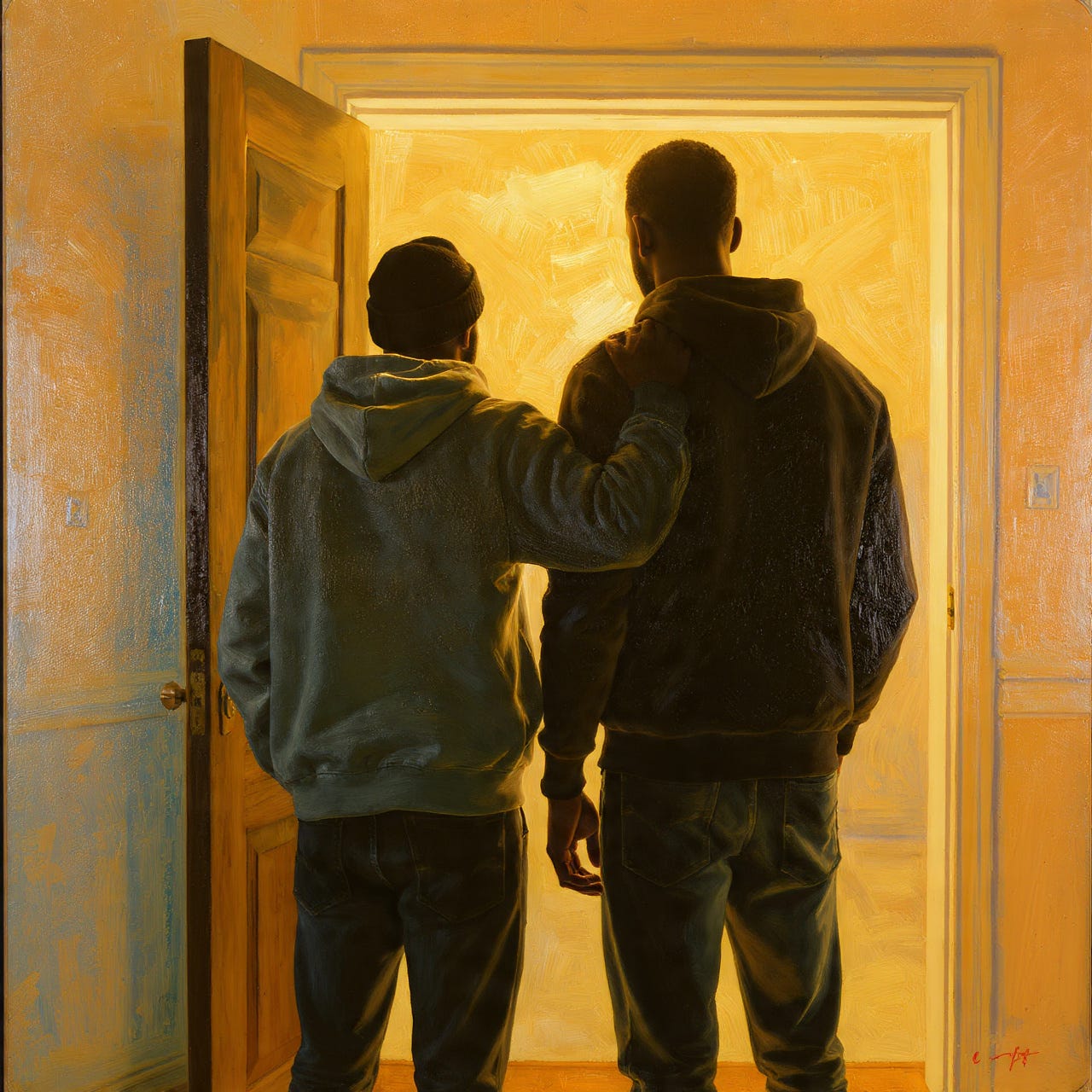
This letter is written to a mentee of mine, a young Muslim creative who was paralyzed by his own work. If it finds you in a similar place, it belongs to you too.
I know what you were really saying.
Not that the files crashed—though they did. Not that work had piled up—though it had. What you were saying, underneath all of it, was something more subtle and more painful: that someone else should be doing this. That whoever narrates this thing, whoever puts their voice to it, it probably shouldn’t be you.
Habib (beloved), I know that feeling. Not because I’ve sat with others who’ve carried it—though I have. But because I’ve carried it myself.
I have been sitting with the idea of a podcast for nearly a decade.
Not casually, either. Not the way you half-consider something and let it drift. This has been a recurring thought—something I keep returning to, put down, and find waiting for me again. And every time I return to it, the same questions come with it.
Why should I be speaking? There are scholars I’ve sat with, teachers who shaped me, whose knowledge of this tradition runs deeper than mine will likely ever reach. Whatever I have to offer, they have it better and more completely.
What unique thing would my voice bring? The Muslim content space is not short of voices. I would scroll through what already existed and struggle to find the gap I was supposed to fill.
Those questions don’t have clean answers. And underneath them, always, is the one that resists argument most: whether the motives beneath all of this are what I tell myself they are. The doubt knows that question has no floor. It doesn’t raise it; it helps purify your intentions. It raises it to keep you still.
What finally moved me wasn’t resolution. It was a particular kind of exhaustion—with myself, with my own avoidance. I spent too long watching other people’s creative work from a distance, carrying opinions about it, without producing anything of my own. At some point, the gap between what I claimed to believe and how I was actually living became too uncomfortable to ignore. So I started. The doubt is still present. The comparisons to my teachers are still there. I am still pushing anyway.
I think you know exactly what I’m talking about.
The file crash didn’t cause the paralysis—it gave it somewhere to hide. You said it yourself: you already had doubts about those clips before anything disappeared. It’s easier to blame corrupt files than the real thing, and the real thing, I think, was already written before the files ever crashed.
This is what the doubt does. It’s waswasa (satanic whispering). It doesn’t come for careless work—it has no interest in things that don’t matter to you. It shows up precisely where your sincerity does, in the work you actually want to be good at, and plants itself right between you and the making of it. The more the work means to you, the more exposed you feel attempting it.
And then you said the thing I haven’t stopped sitting with since.
“I was thinking what might be better is actually having you or someone else narrate.”
I hear the humility in that. I do. But what you were proposing wasn’t stepping back—it was stepping out. Not finding someone more capable to carry the work further, but removing yourself from your own creation altogether. Those are very different things, and I love you too much to let that pass without saying so.
The desire to be heard—to have your work matter, to be recognized—is not something that disqualifies you. It is human. What our tradition asks is not that we arrive at the work with a perfectly clean heart, but that we keep returning our intentions to Allah through the work, imperfect as they are. Ikhlas (sincerity) is not a threshold you clear before you begin. It is a practice you sustain from the beginning, through the making, and into whatever comes after.
Think about who built what you and I have inherited. Imam Al-Ghazali (d. 505/1111) spent a lifetime teaching and writing about sincerity while openly acknowledging its elusiveness—that intention without sincerity is ostentation, and sincerity without ongoing realization is worthless.1 He did not arrive at those words from a place of settled purity. He wrote his way toward them. They did not wait for certainty before putting words down.
The question worth sitting with isn’t whether my intentions are clean enough to justify this. That question has no satisfying answer, and it was never meant to. It is this: am I willing to keep offering this to Allah, mixed motives and all, and trust Him to receive and purify what I cannot?
This, I think, is where tawakkul (trust in Allah) does its deepest work. Not trusting that you are ready. Not trusting that your heart is pure. Trusting that Allah can work with what you actually are.
Did Allah place this in your hands? Not whether you are skilled, nor whether your intentions are spotless—whether this work arrived in your life as a gift from somewhere other than yourself. If it truly did, and perhaps assessing that is found in shura (consultation), then the question of worthiness has already been answered by the One who gave it. This is tawfiq (divine enablement). Allah does not extend a gift without extending alongside it the capacity to carry it—whether that capacity already lives in you, or whether the carrying itself is how it will be formed. The gift always precedes the readiness. No offense, but what has positioned you for this is not something extraordinary in you. It is simply that Allah, in His wisdom, chose to give it to you.
That’s why what you proposed wasn’t humility—it only wore humility’s clothing. True tawadu (humility) shows up. It hands the imperfect thing over and steps back. What you were describing never arrives—it keeps revising, keeps deferring, keeps insisting someone better should carry this, and quietly calls that modesty. To withdraw from your own tawfiq is, at its root, a failure to trust that Allah knew what He was doing when He gave this to you. And I say that not to correct you from above—I say it because I have made the same mistake, more times than I can count.
The question worth asking isn’t, “Do I have what it takes?” It is, “Do I trust the One who placed this in my hands?”
That question is what moved me off the sideline and into the room with you to record the first episode.
Habib, I did not choose you for this project because I felt sorry for you. I did not choose you because no one else was available, or because I needed someone to fill a role. I chose you because I trust your creative eye. I have seen how you see things—the instincts you bring, the way you frame and feel a moment, the beautiful care for the community you embody—and I believe in what you carry. That is not encouragement offered to keep you moving. It is what I actually think.
The voice that belongs on this work is yours—hesitant, still forming, carrying motives you haven’t fully sorted—because Allah gave this work to you, not to someone else. Pick up the camera. Edit the clips. Send them over.
Not because you feel ready. Not because the doubt has cleared or the questions have resolved. But because the gift was given, and tawakkul is what it looks like when you act as though you believe that.
Keep checking your intention, returning your focus to Allah. That returning is not a sign that you haven’t arrived. It is the practice itself. It does not end for any of us.
This is your work. Stay in it.
Ultimately, with Allah is all success.
Abu Hamid al-Ghazali, Iḥyāʾ ʿUlūm al-Dīn, 4 vols. (Cairo: Muṣṭafā al-Bābī al-Ḥalabī, 1939), 4:361.
Preach, sheikh, preach!
whenever a friend asks me about ikhlas, I tell him ikhlas is impossible so don't bother trying to achieve it.
just go and do the thing with as much or as little sincerity as you can muster, and pray that Allah swt accepts your efforts and forgives your shortcomings.
Sheikh, you've said this very very beautifully. may Allah swt grant us all the tawfiq to use the gifts He's granted us to serve Him in the ways He wants from us.
Jazakillahu khairan for this hopeful and inspiring post