

I
Not long ago, one of our co-founders told our small team he has high aspirations for what we are building; specifically, he wants us to be professional and world-class. He, like several of the people we work alongside, has built and sold companies, some of them unicorns (startups valued at more than a billion dollars), so when they use the word “professional,” it carries the weight of what they have actually done. I had nothing to measure those words against. My entire professional life has been in the Muslim nonprofit space, nearly all of it inside the masjid, and when he said “professional,” I had no reference for what it should mean for us. What establishes it? When we call a piece of work professional, or an institution world-class, whose standard are we reaching for—and is it simply the one that corporations have refined and standardized over the last century? I did not have an answer, and the longer I pondered the question, the more I suspected that most of us have never been asked to have one.
In Makkah, I asked the driver about his life and his country in every cab I rode. Saudi elders gave me a window into Bedouin culture and custom. Their lives exposed what mine had hidden from me. Over more than a decade of serving in masajid and community spaces, that same habit of asking and listening is what taught me to empathize with people and care for them pastorally, and when I began writing here a few years ago, it became the muse and source of what I wrote about. Nearly every essay on this blog began that way—something seen, something that would not leave, and an attempt to name it before it hardened into habit.
Some of the earliest excellence we encountered was never named as excellence at all. As a Blackamerican child in a predominantly immigrant masjid, I was welcomed by elders who shared neither my background nor my culture, who made room for me not because I resembled them but because of their own grounding in adab (proper conduct, the outward form of an inward reverence). I have written about them before, in “The Masjid Kids’ Uncles” and again in “Cultivating Community”. No one measured what they did, and no one thought to. And yet when we ask what made the masjid a place we kept coming back to, it was them—and the sense they gave us that we belonged there and that our presence mattered.
Anas ibn Malik was a boy of about ten when he was brought to serve the Prophet ﷺ in Madinah. He served him for ten years and later described those years in a single sentence: “He ﷺ never once said to me ‘uff,’ nor did he ever ask of something I had done, ‘Why did you do that?’ or of something I had left undone, ‘Why did you not do that?’”1 A boy of ten makes mistakes every day. What Anas remembered was not that nothing went wrong, but how the one who held all the authority responded when it did.
We rarely call either of these professional: the elders’ welcome of a boy who was foreign to them, or the Prophet’s ﷺ patience with Anas for ten years. What made each of them excellent lies outside anything a performance review is built to see. Yet if we were asked to name the most excellent conduct we have ever witnessed or read about, I suspect many of us would reach for something like them long before we reached for a quarterly result.
The Quran describes people “with hearts they do not use for comprehension, eyes they do not use for sight, ears they do not use for hearing.”2 Their eyes work. What fails is the seeing behind the eyes—the way the heart decides what is worth noticing before the eye ever lands on it. In the Quran’s language, seeing is a moral act, and what we notice, and what we pass over as unremarkable, says something about the state of the one who is looking.
I learned about Tahrir Square during the Arab Spring directly from Egyptian cab drivers, and I see now that I was learning their frames as much as the facts. Modern cognitive science has its own way of describing this. George Lakoff calls the structures behind our seeing frames: “mental structures that shape the way we see the world.” As a result, he writes, “they shape the goals we seek, the plans we make, the way we act, and what counts as a good or bad outcome of our actions.”3 A frame does not feel like an opinion. It feels like common sense, which is exactly why it is so difficult to question. When we hear “professional” and “world-class,” we are not hearing two neutral adjectives. We are hearing a frame, inherited whole, that has already decided what excellence looks like and who gets to measure it.
Frames are only part of it; beneath them, something happens to what we value. The things we care about most are rich and hard to measure: care, learning, the formation of a person over years. What we can count is much simpler: grades, reviews, followers, steps. The philosopher C. Thi Nguyen calls what happens next value capture.4 We begin by using a measure to serve something we love, and over time, without ever deciding to, we start loving the measure instead. The number was supposed to point toward the good. Eventually it becomes the good, and we stop noticing the difference.
For years I wrote about what I saw in our communities, but we rarely interrogated the frame through which we were seeing any of it, or whose measure we had already accepted before we began to look. The invitation to be professional and world-class did not create that question; it only made it harder to avoid. The task now is to turn and examine the eyes we have been seeing with—and to ask whose they are.
II
What those eyes were trained on, for most of my working life, was a particular set of questions. Different rooms, different boards, and the conversation always took the same shape: how do we increase attendance, how do we sustain the budget, how do we improve programming, how do we reach more people online. I wrote about those meetings in “The Product We Became,” and what I said then still holds: these are reasonable questions, and I have asked them myself. What took me longer to notice was what never made the agenda. Every Ramadan the rows fill, and the reports celebrate the numbers. Just days after Eid most of those people are gone, and the same reports rarely ask where they went, or whether anyone noticed.
The habit of trusting what can be counted did not begin in our boardrooms. It is older than the American masjid, and it began, of all places, as a form of devotion. In seventeenth-century England, Puritan preachers set out to dismantle a hierarchy in which the monk and the priest stood closer to God than the farmer or the servant. William Perkins told his listeners that if we compare work to work, “there is a difference betwixt washing of dishes, and preaching of the word of God: but as touching to please God none at all.”5 Every useful labor became a calling, and the test of a calling was its intention. Those who worked “to get honours, pleasures, profites,” they warned, profaned their lives; the aim was “to serve God in the serving of men.”6 The philosopher Charles Taylor calls this the affirmation of ordinary life: the conviction that the good life is lived not above ordinary work and family but inside them.7 The English bishop Joseph Hall put the whole conviction into a single line:
God loveth adverbs; and cares not how good, but how well.8
We cannot hear that sentence without hearing the hadith of Jibril behind it. But over the next three centuries the sentence was slowly cut in half. The seriousness about work survived: the discipline and the conviction that ordinary labor matters. What fell away was the One it was for. As thinkers like John Locke recast God’s purposes as human preservation and improvement, and later writers dropped God from the account altogether, “how well” remained and “God loveth” disappeared.9 Excellence was still demanded. It simply needed a new witness, and it found one in the employer, the client, the market, the review. That inheritance is what we now call professionalism. Taylor observes that the affirmation of ordinary life has become “too pervasive to be noticed,”10 which is why it feels like common sense rather than history.
The same modernity that took God out of work did not abolish faith. It made faith one partner among several (work, career, the market, the family), each with its own rules and its own measure of a good life.11 My Tajik roommate in Makkah came from a secular state that closed unregistered mosques and barred the hijab from its schools; he was studying Islam in Saudi Arabia illegally in the eyes of his own government, which could not learn what he was studying. There were summers he and other Tajik students did not go home, because going home could mean prison. Ours needs no law at all: faith is simply given its share. Allah sets forth the parable of a man owned by quarreling partners and a man belonging wholly to one master, and asks whether the two are alike.12 That is the shape of a divided life, and goodness itself gets divided among the partners. When the claim is worship, goodness means prayer, fasting, and avoiding the forbidden, and we call it Prophetic. When the claim is work, goodness means competence, reliability, and polish, and we call it professional. Each partner tends to speak only of its own share. Many of us live as the first man without noticing.
In “The Product We Became,” I drew the line in a particular place. “Professionalism is good,” I wrote. “It is necessary.” The problem, I argued, was consumerism: the moment excellence became the goal rather than the means. I still believe most of that. Competence and trustworthiness are real goods; the Quran itself says that “a strong, trustworthy man is the best to hire.”13 But we drew the line at consumerism because consumerism was what we could see. The measure does not need consumerism to capture what it serves. It happens whenever excellence answers to an audience rather than to Allah, and that can happen in the most competent institution, run by the most sincere people.
Which is how the question found me again. My work no longer sits inside a masjid; it sits in the wider field of Muslim engagement and thought, among people whose standards are real and from whom I have learned. What I could not answer was where that good comes from for us, and who is watching when we reach it. If the measure was not only in the institutions, it was also in those of us who had been watching them.
III
The question our co-founder raised cannot be answered by any standard we borrow. It can only be answered by asking who the witness is.
When the angel Jibril (‘alayhi salam, peace be upon him) asked the Prophet ﷺ about the religion, the answer came in three parts. Islam was the practice: prayer, fasting, charity, pilgrimage. Iman (faith) was the root it grows from. And ihsan (excellence) was “to worship Allah as though you see Him, for though you do not see Him, He sees you.”14 Ihsan harmonizes the other two and gives them depth, turning practice into worship and belief into presence. A faith that has become one of the quarreling partners, compartmentalized and kept to its own share of our lives, tends to keep the first two. It prays, it fasts, it believes. What it loses is the third, because ihsan cannot be confined to one partner’s share. It is the part of the religion that refuses to stay in its place, that follows us into the meeting, the report, and the kitchen, and asks the same question everywhere: who is watching? My Tajik roommate lived this. He would not keep his faith in the share his government allowed it, even when it cost him his summers at home. Ihsan is what returns the whole of us to one Master.
The tradition also has a word for excellence in the work itself: itqan (mastery, doing a thing thoroughly and well). The Quran uses its verb, atqana, for creation itself: “the handiwork of God who has perfected all things.”15 Elsewhere it uses ahsana for the same work: God “gave everything its perfect form.”16 The two words overlap, and the dictionaries often define one by the other. But each leans a different way: itqan toward the soundness of the thing made, ihsan toward the beauty of the making and the heart of the one who makes it. And when the Quran turns to our work, it reaches for ihsan: we were created “to test you [people] and reveal which of you does best.”17 Allah has prescribed ihsan in all things, the Prophet ﷺ taught, in a teaching about something as ordinary as slaughtering an animal gently.18 If excellence is owed even in that moment, it is owed in every task we touch. This is where Hall’s sentence becomes whole again. The demand for “how well” was always sound; what we lost was the One who loves it.
Nguyen observes that institutional metrics are blunt instruments, unable to register what is intimate and particular about a life.19 The Witness of ihsan is the opposite. He is Al-Latif Al-Khabir (the Subtle, the All-Aware),20 nearer to us than our jugular vein.21 Nothing about our work is too small or too private for Him to see. The answer to value capture is a Witness more particular than any measure we could build.
The Prophet ﷺ described the first three people to be judged on the Day of Resurrection: a scholar, a man who died fighting, and a generous giver. Each is reminded of what he was given and recounts what he did with it, and each is told that he did it so it would be said of him that he was learned, that he was brave, that he was generous—”and it was said.”22 Nothing in the narration suggests the work was poor. By any standard we use, it was excellent, and that is what makes the hadith so frightening. They received exactly what they worked for. The audience paid them in full.
For some of us, that hadith lands as terror, and we begin to audit every motive until we can no longer act. But the tradition does not ask us to arrive at the work with a clean heart, only to keep returning our intentions to Allah through the work. The fear of showing off is a sign that the heart is still alive. If we stop doing good work because others might see it, their eyes are still deciding what we do.
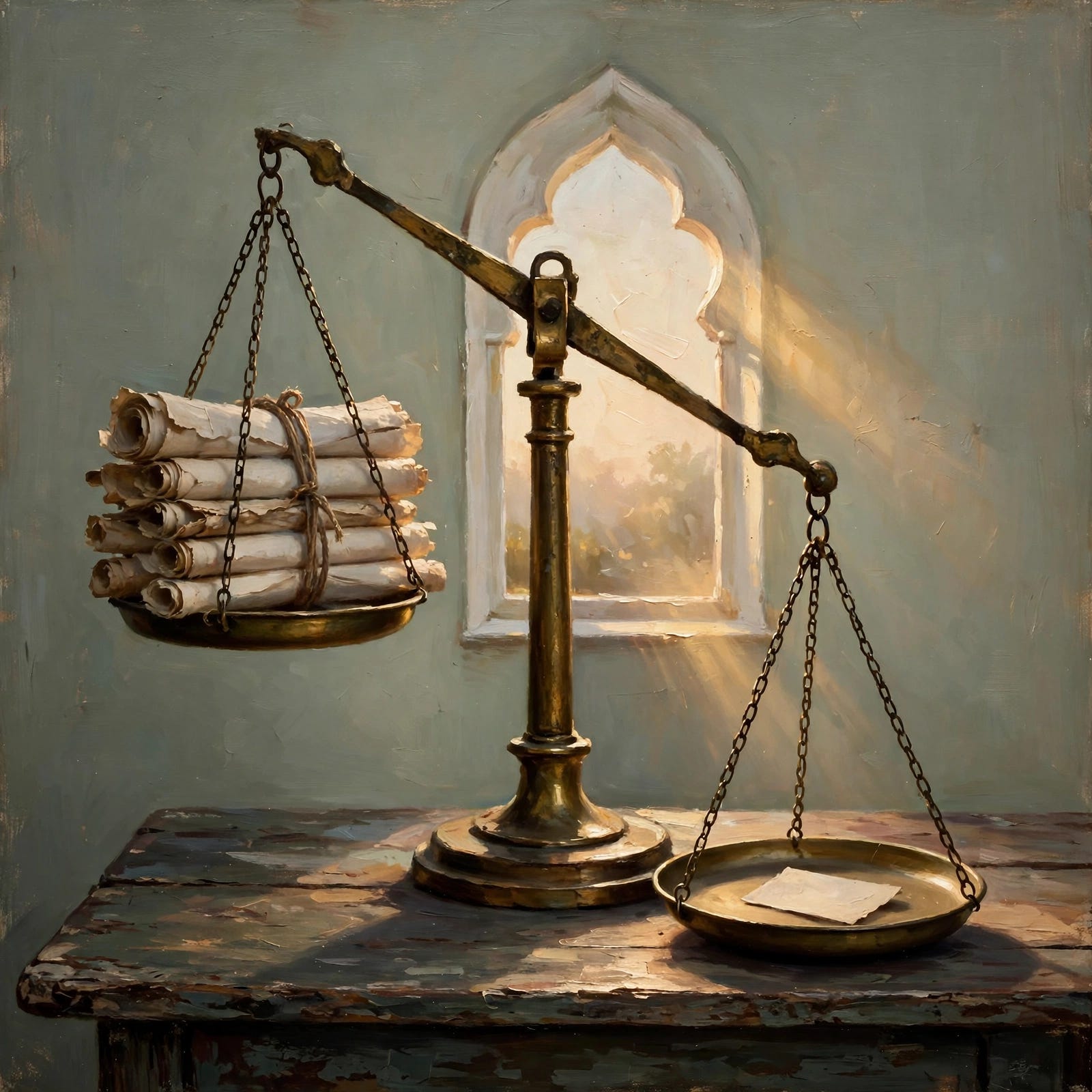
Many of us learned as children to count our good deeds, down to the smallest: even a smile at a brother, the Prophet ﷺ said, is charity.23 Some of us still keep the tally. So the question is fair: is Islam not the greatest scoreboard of all? Every deed is recorded, good deeds are multiplied, and on the Day of Judgment deeds are placed on a scale. But the Recorder is not a metric. “Actions are only by intentions,”24 and the One who weighs them sees what no score can. A man, the Prophet ﷺ told us, is shown on the Day of Judgment ninety-nine scrolls of his sins, each stretching as far as the eye can see; then a single card bearing the shahada (testimony of faith) is placed on the scale, and it outweighs them all.25 No institution’s measure could produce that result. Only a Measurer who sees the heart could. And even the full ledger is not what saves us: the Prophet ﷺ taught that no one’s deeds will admit him to Paradise, not even his own, unless Allah covers him with His mercy.26
When the Witness returns, the question we began with changes shape. Goodness is no longer divided between a Prophetic share and a professional one; it is one thing, owed to one Master, in the masjid and the office alike. Our worth no longer rests on what we produce or how we are rated, because “in God’s eyes, the most honoured of you are the ones most mindful of Him.”27 And results return to where they belong. On the Day of Judgment, the Prophet ﷺ said, some prophets will come with a small band of followers, some with one or two, and some with none at all.28 Not one of them failed. Professional and world-class, then, are not the wrong aims. They are too small, and pointed at the wrong eyes.
None of this asks us to stop measuring. The tradition has always kept accounts; Umar ibn Al-Khattab is reported to have said, “Take account of yourselves before you are taken to account.”29 What it asks is that we stop borrowing our measures whole. The corporate world built its standards for its own ends, and some of them serve us well. But we are free to look deeper and set measures that answer to our own: whether the people in our care were actually served, whether the work was done thoroughly, whether we did it for the One who sees it. Those measures are harder to count, and they will never fit neatly on a slide. They are also the ones that can tell us whether our work was excellent in the sense that matters, and they keep the number in its place, as a servant of the good rather than its replacement. The challenge is to stop asking only whether our work looks professional, and to start asking what it is for.
I am grateful our co-founder pushed us the way he did. A call to be professional and world-class could easily have sent me looking for better numbers to chase, which is exactly how value capture begins: a borrowed measure, adopted in good faith, until it gradually becomes the goal. Instead, because I had no reference for his words, the push sent me looking for the standard beneath them, and made me ask what excellence is for and whose eyes it answers to. I would not have asked those questions without him, and I am better for having been pushed to ask them.
Each of us is a shepherd, the Prophet ﷺ said, and each of us is responsible for our flock: the leader for the people, the man for his household, the woman for her husband’s home and children, the servant for what has been placed in his hands.30 We will be asked. But the question will come from the One who saw everything, including what no one else counted: the uncles who made room for a boy who was not theirs, and a servant who for ten years never once heard the word “uff.”
Ultimately, with Allah is all success.
George Lakoff, The All New Don’t Think of an Elephant! Know Your Values and Frame the Debate (White River Junction, VT: Chelsea Green, 2014), xi–xii.
C. Thi Nguyen, The Score: How to Stop Playing Somebody Else’s Game (New York: Penguin Press, 2026), 42–43.
Charles Taylor, Sources of the Self: The Making of the Modern Identity (Cambridge, MA: Harvard University Press, 1989), 224, quoting William Perkins.
Taylor, Sources of the Self, 225.
Taylor, Sources of the Self, 211–33.
Taylor, Sources of the Self, 224, quoting Joseph Hall.
Taylor, Sources of the Self, 234–39.
Taylor, Sources of the Self, 498.
On the modern idea of “religion” as a private sphere of belief and ritual, see Talal Asad, Genealogies of Religion: Discipline and Reasons of Power in Christianity and Islam (Baltimore: Johns Hopkins University Press, 1993), and Olivier Roy, Holy Ignorance: When Religion and Culture Part Ways (New York: Columbia University Press, 2010).
Quran 32:7. The two words share much of their range, and the lexicographers often define one by the other. Ibn Manzur (d. 711/1311), Lisan Al-Arab, s.v. t-q-n, defines itqan as ihkam, making a thing firm and sound; s.v. h-s-n, he defines ihsan as the opposite of isa’a (doing badly): doing a thing well or beautifully, and doing good to another. Al-Zabidi (d. 1205/1790), Taj Al-Arus, follows both entries. The emphasis drawn here, itqan toward the soundness of the work and ihsan toward the beauty of the making and the one who makes it, follows those definitions.
Nguyen, The Score, 50.
A statement attributed to Umar ibn Al-Khattab, cited by Al-Tirmidhi in his commentary following Jami At-Tirmidhi 2459.