

This is the fourth and final part of a Ramadan reflection. Read the first part here, second part here, and third part here.
Ramadan is almost over. And I am not sure whether to grieve that or exhale.
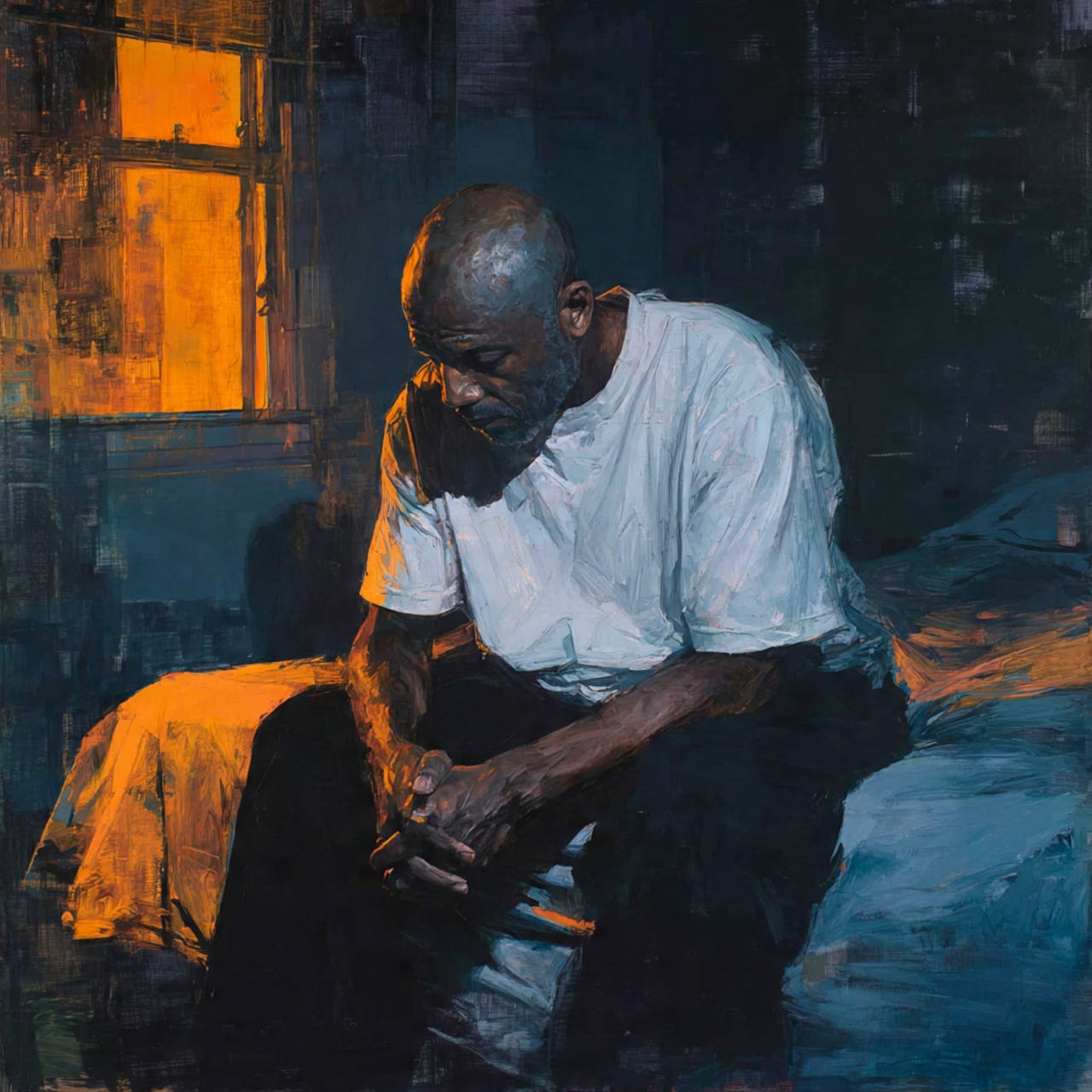
My body no longer knows what time it is. Thirty days of broken sleep—late nights stretched toward suhoor (the pre-dawn meal), alarms pulling me back before I was ready—have left me in a kind of fog I cannot quite think my way out of. I am tired in a way that is neither spiritual nor metaphorical. It is just physical. The kind of tired that does not carry meaning, that does not dignify itself as sacrifice. Just physical exhaustion.
Part of me is glad the month is over. Not relieved—glad. And the moment I noticed that gladness, something in me recoiled a bit. It felt wrong. It felt like the kind of thing you are not supposed to say out loud, certainly not at the end of the holiest month of the year. But it was there. It is still there.
And yet—underneath that, or alongside it, I am not sure which—something else is sitting there. A tenderness toward this month that I was not expecting. Because something was given, even inside the fog. Even inside the shortfall. Most of it I am keeping to myself. But I know it arrived.
So I am holding both things at once: a body that is ready to rest, and a heart that knows what it received.
The Man Who Named the Worst Thing
There is a companion of the Prophet ﷺ I keep returning to this week. His name was Hanzalah ibn Rabi’ah al-Usaydi (may Allah be pleased with him). Most people do not know who he was. But his story is one of the most honest things in the entire tradition, and I have been living with it for days.
Hanzalah was not a peripheral figure. He was among the kuttab al-wahy—the scribes of the revelation itself.1 When verses of the Quran descended upon the Prophet ﷺ, Hanzalah was among the men trusted to write them down. His hands held the words of Allah as they arrived. His proximity to the Prophet was not occasional. It was daily.
And one day, he ran to AbuBakr al-Siddiq (may Allah be pleased with him) in a state of spiritual panic.
He said: “Hanzalah has become a munafiq (hypocrite).”
Not—I am worried I might be. Not—I feel far from Allah lately. He said: Hanzalah has become one. He had already written the verdict against himself. And what I notice, reading this story now at the end of this Ramadan, is that he did not say “I.” He said “Hanzalah.” As if he were reporting on someone he was watching from a distance. As if the gap between who he was in the Prophet’s presence and who he became in ordinary life felt so wide that he could not hold both inside the word “I” at the same time.
Abu Bakr did not rush to reassure him. He listened. And then he said: “By Allah—I experience the same thing.”
Two of the greatest human beings who ever lived. Standing together, not pretending. Not managing their spiritual states for each other. Just honest. And then—this is the part I keep sitting with—they did not stay where they were. Together, they walked to the Prophet ﷺ. The movement itself was something. Hanzalah’s instinct, even in his worst moment, was toward the source of light. Not away from it.
A Time for This, and a Time for That
Hanzalah explained his distress to the Prophet ﷺ: when I am with you, the akhirah (hereafter) feels visible. My heart is alive, present, moved. But when I return to my wife, my children, the ordinary rhythms of life—it fades. All of it fades. And I am afraid of what that means about me.
The Prophet ﷺ’s response was profound, yet simple: “By the One in Whose Hand is my soul—if you remained as you are when you are with me, the angels would shake your hands on your roads and in your beds. But Hanzalah—there is a time for this, and a time for that.”2
He said it three times.
I have been sitting with those words for days now. He ﷺ names something true about the human heart: it was never designed to live permanently at the peak. The aliveness at the summit is real. The fact that it cannot be maintained from the valley is not a failure of iman (faith). It is the nature of the human heart.
What the Prophet ﷺ does not say is as important as what he does. He does not say, "You are broke.” He does not say, "Stay where you are.” He says, "There is a time for this. And a time for that.” Which means both times are real. Both times belong to a life of sincere worship.
The rhythm is the design—not the deviation from it.
I did not know, when this Ramadan began, that I would end it here.
What Hanzalah Showed Me
I keep returning to Hanzalah not for the Prophet ﷺ’s answer, but for what Hanzalah did before the Prophet ﷺ ever spoke.
Hanzalah said the true thing out loud. He did not manage it, soften it, or wait until he had something more composed to offer. He walked into the room and said the worst version of what he feared about himself. I want to carry that past this month. Not the curated version of myself—not the version that knows how to talk about struggle without actually being in it. The one who says: here is what is actually happening in me. Even when—especially when—what is happening in me is not yet a lesson.
He ran to someone who said, “I feel it too.” Abu Bakr did not fix his problem. He accompanied it. He named his own experience and let Hanzalah feel less alone in it. That small act—I feel it too—costs almost nothing and carries more than most people know. This is the kind of suhba (spiritual companionship) I need to prioritize in my life. People who are courageous enough to respond honestly, rather than reassuringly. If this Ramadan taught me anything, it is this specific kind of honest companionship I actually want to build for others, too. Rijal: Men’s Formation Community is an attempt to do that systematically.
And when companionship was not enough, Hanzalah kept moving. He did not stop at Abu Bakr and call it quits. He walked toward the source of light. He had access to the Prophet ﷺ and he used it. I do not have that. But I have the Quran, the tradition, the scholars who carried what the Prophet ﷺ left. That is where the movement leads. Not toward feeling more—toward seeking more. Even on days when the light feels very far away, and the walk feels mechanical, and the heart is quiet.
I wrote once that “a sign of a live heart, filled with Iman, is that obeying Allah conjures an emotional response—but that emotional response is not the goal, rather pious actions.” I knew what I meant when I wrote it. This Ramadan, I had to reckon with whether I actually believed it. Feelings are not what I am supposed to be worshipping. Allah is. And the distance between knowing that and living it turns out to be longer than I thought.
I’m sure there will be mornings after this Ramadan when Fajr (the dawn prayer) feels impossible. When the Quran sits on the shelf and I know it and feel the weight of knowing it. When the person I was on the twenty-fifth night feels like someone else entirely. And I will have to get up anyway. Not heroically. Just faithfully. The Prophet ﷺ prayed until his feet swelled. When Aisha (may Allah be pleased with her) asked why, given that Allah had already forgiven all his sins, he said: “Should I not be a grateful servant?”3 That was not a feeling he was waiting for. It was a posture he chose, again and again, regardless of what his body or his heart were carrying that day.
Tawakkul (complete reliance on Allah) is not the absence of action. It is the presence of trust inside the action. You tie the camel—you do the thing that is yours to do—and then you open your hands, because what happens next has never been in them. That is not passivity dressed up as faith. That is faith doing what faith actually does.
But I want to be honest about where I am standing right now, at the end of this month. I still owe myself a real accounting—a post-Ramadan debrief where I sit down and look clearly at what I protected and what I let slip, where I was faithful and where I was not. I have not done that yet. And before I even begin: I missed more than I accomplished. The ledger is not in my favor. More days fell short than I want to admit.
I cannot do that work tonight. Tonight I need to rest. I need to let my body find its way back to itself—to sleep without an alarm, to wake without obligation, to let the month settle before I try to assess it. And somewhere inside all of that—underneath the exhaustion and the honest shortfall—I need to be grateful. Quietly, specifically grateful. The gifts did not arrive despite the difficulty. They came through it.
There is a time for this. And a time for that.
I am learning to trust that both of them belong to Allah.
The muhasabah (self-accounting) will come. But, rest first.
Ultimately, with Allah is all success.
Ibn Hajar al-Asqalani (d. 852/1449), Al-Isabah fi Tamyiz al-Sahabah. Hanzalah ibn Rabi’ al-Usaydi is listed among the kuttab al-wahy (scribes of the revelation). He was known by the epithet al-Katib (the scribe) and served as a relief scribe, trusted to stand in for any member of the scribal circle when absent.
I would like to add that doing Ramadhan in a western country (if this is the case) certainly leads to exhaustion because you must perform, work and mantain the same schedule as if you were not fasting. May Allah accept our fasts and out efforts.
SubhanaAllah, Ramadan is not supposed to be an easy walk in the park. That's why it's one month in the year, because Allah knows that this what we can bare. We all are grieving the month, yet happy it's over. Makes sense that it ends with Eid celebration. May Allah accept all you fasting, prayers, and good deeds. Eid Mubarak