

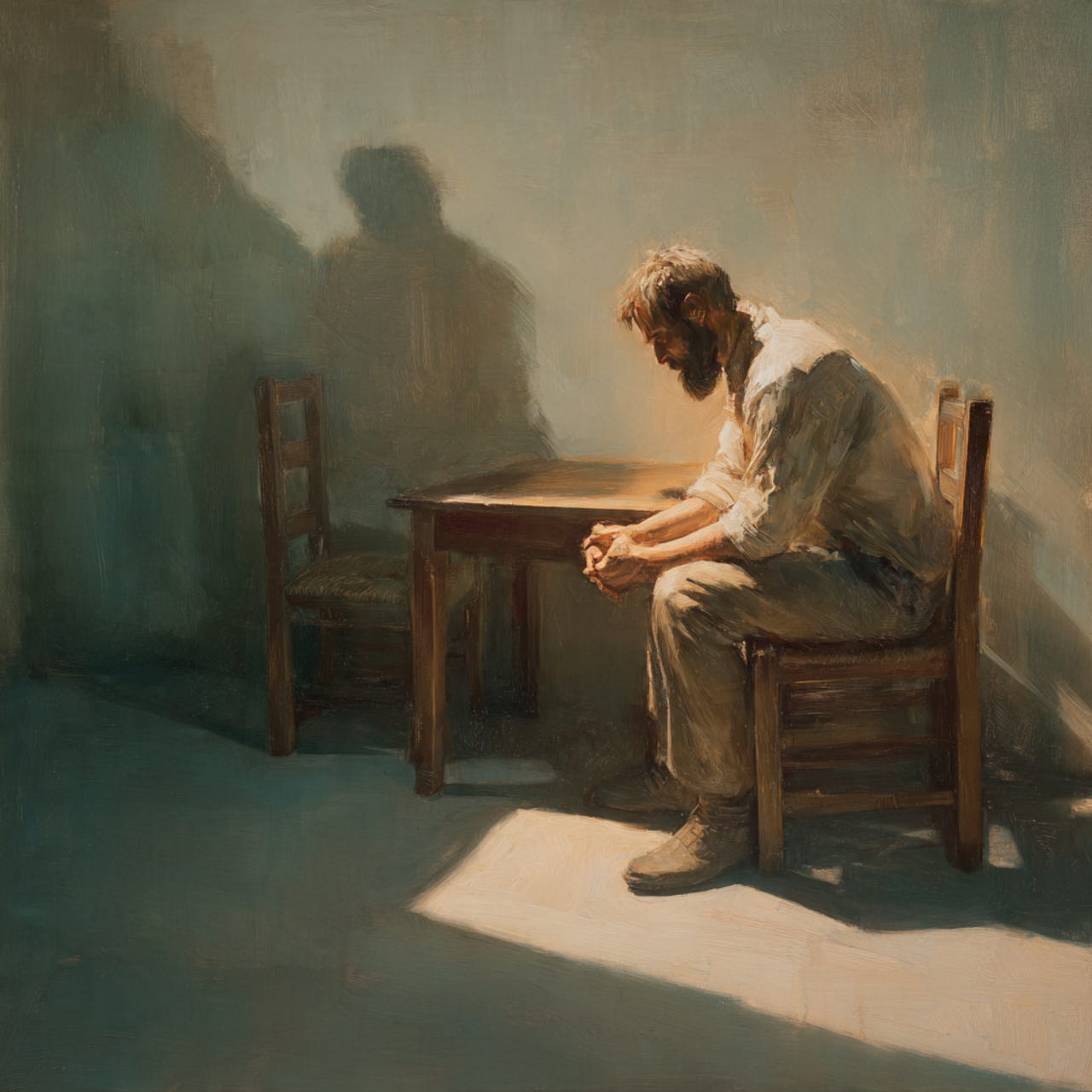
The Rishta Uncle
I built a small app recently, not because I had any technical background for it—I don’t—but because I kept having a version of the same conversation. Young men asking about nonnegotiables, then sending me updated lists after we talked. The lists would come back longer, more specific, and reordered. They were not getting more useful. I thought: maybe if the input were cleaner, the process would move.
The app barely has users yet.
What I keep noticing—in the conversations that preceded it and continue alongside it—is that nonnegotiables are not actually where the paralysis lives. The men who come to me with their lists are not stuck because the list is wrong. They are stuck somewhere prior to it, somewhere no tool was ever going to reach. They want marriage. That part has never been in question. What I keep watching from across the table is their capacity to move toward it—and what keeps interrupting that capacity, dressed as something else.
What follows is my attempt to honor what those brothers have trusted me with for the last ten years.
The Landscape
The average American man married at 23.5 years old in 1975.1 In 2024, that number is 30.8.2 Seven years is not a rounding error. It is not a statistical artifact produced by shifting demographics or changing definitions. It is a generation-wide pattern with structural causes, and patterns at that scale do not originate in individual failure. Something changed in the world before it changed in the men.
Anxiety diagnoses among young adults nearly doubled in the decade between 2008 and 2018 alone.3 The friendship crisis is starker still: 15% of men today report having no close friends, compared to 3% in 1990.4 The relational muscle that marriage requires—the capacity to remain inside difficulty, to repair rather than exit, to hold another person’s interior life alongside one’s own—is built through friendship, through the specific intimacy of being known by someone over time and knowing them in return. That muscle has atrophied across an entire generation.
Then there is the question of models. The shift from extended family networks to detached nuclear units—what David Brooks called a move that “liberates the rich and ravages the working class”5—stripped away the informal apprenticeship that once carried young men through this passage. The older brother whose marriage we watched closely enough to learn something real. The uncle who had done it, imperfectly, and whose imperfection was itself instructive. The community that surrounded a couple was not just an audience but a structure. But the loss is not only structural. In 1940, roughly a quarter of Americans lived in multigenerational households; by 1980, that figure had fallen to 12%.6 The nuclear family did not simply replace the extended one as a practical reality—it replaced it as an aspiration. Privacy became a virtue. Independence became maturity. The young man who still takes counsel from his elders and still expects his community to have a role in his marriage is now the exception. And sometimes he is made to feel that the exception is a deficiency.
Western individualism did the rest, reframing marriage as a site of personal fulfillment rather than something a person builds and gives himself to. Inside that frame, the risks feel disproportionate, and the rewards feel uncertain. Of course, something froze.
The Abundance Trap
Barry Schwartz documented it carefully: when options multiply past a certain threshold, satisfaction decreases rather than increases, and commitment—the capacity to choose and stay chosen—erodes.7 More options produce not more confidence but more anxiety, because the exit is always visible. The question is never settled. Something potentially better remains perpetually one swipe away.
Aaron Ben-Zeʻev’s research sharpens this. Romantic abundance makes finding partners easier and sustaining them harder.8 The distinction he draws is between romantic intensity—novelty, chemistry, the electricity of someone new—and romantic profundity, the deep, stable, time-built intimacy that actually holds a life together. Digital culture is extraordinarily good at producing intensity. It is structurally opposed to producing profundity because profundity requires conditions that the medium cannot provide: time, friction, the slow accumulation of ordinary moments that cannot be curated, filtered, or swiped past.
What this training produces over time is not hard to see. The meritocracy scale—who is objectively the most attractive, the most accomplished, the most impressive—has quietly displaced the suitability scale: who actually fits my life, my limitations, my actual capacity to love rather than my idealized image of it. This is not evidence of moral failure—it is evidence of what the medium does to judgment when judgment is exercised inside it long enough.
86% of young adults say they expect to be married for life.9 The gap between that expectation and the formation the medium produces is wide enough to grieve in.
The Interior Wound
When a young man comes to me asking about his nonnegotiables, my first instinct is gratitude. He is trying. He is being thoughtful about something most men approach without any framework at all. That counts for something, and I want to honor it.
But there is a moment in those conversations—it comes reliably, usually within the first twenty minutes—where I ask something that requires him to think critically about what he actually wants versus what he has been told to want, and he cannot go there. Not because he is incapable. Because no one has ever asked him to before, and the question lands somewhere he does not have language for yet. I have learned not to take that personally. What I have not been able to shake is the frustration—not at him, never at him, but at how consistently the system has failed to prepare him for a question this basic. He arrived thoughtful. The thoughtfulness has no foundation to stand on.
That is what the lists were revealing. Not a lack of care. A lack of formation.
The fear, dressed in the language of standards. The perfectionism, dressed in the language of discernment. The indefinite delay is dressed in the language of readiness. And underneath all of it—something I did not expect to find as consistently as I find it—a genuine, often unspoken guilt. The young man who knows he should be moving and cannot, who has carried that shame long enough that it has become its own reason to stay still.
The fear of choosing wrong runs deepest. The optimization logic of the digital environment is internalized now—the sense that the right process, applied with sufficient patience, will eventually produce the correct answer. The bar for certainty rises as the timeline extends. Every promising person eventually reveals a flaw that functions as a disqualifier because the implicit standard is not a suitable partner, but the absence of doubt. Doubt, it turns out, does not have a floor.
Then there is the self-concept that presents itself as permanently unfinished. “I’m not ready yet” is not always an honest assessment of a man’s preparation. Sometimes it is an identity—a position that can be occupied indefinitely, that asks nothing of the person holding it, that keeps the discomfort of genuine vulnerability at a manageable distance. In this version, the self's completion becomes a prerequisite for life rather than something that happens within it.
The financial anxiety deserves its own moment because it is real and legitimate, and is often extended far beyond what the tradition actually requires. MIT’s Living Wage Calculator—which measures the minimum income needed to cover basic needs, not comfort—puts that floor at roughly $41,700 annually for a single adult in New York state and $40,371 in California.10 High-cost metros run higher, but these are the figures MIT defines as the threshold for covering housing, food, transportation, and healthcare. The bar young men set for themselves before they will consider marriage often exceeds these numbers by a significant margin—and sometimes exceeds the much higher “comfortable” salary, which layers savings and discretionary spending on top.11 The man who cannot imagine proposing until every contingency is secured is not being prudent. He is applying an impossible standard to a decision that was never meant to be made from a fully secure position. The Prophet ﷺ said that food for one suffices two.12 What we have decided stability means, and what stability actually requires, are often not the same number.
I do not say any of this as an accusation. I say it as someone who has sat inside these conversations long enough to recognize what they contain—and who has had to learn, more slowly than I would like to admit, to name what he sees without flinching from it.
The Spiritual Frame
Over ten years of this work, I have heard the language of tawakkul (reliance upon Allah) used in ways that have given me pause. Not because the young men using it were insincere—they weren’t. But because the word was doing different work than its name suggests. Waiting is described as trusting. Avoidance dressed in the vocabulary of patience. The posture of open hands, held not at the end of genuine effort but in place of it.
I have had to learn to distinguish between the two in others, partly by recognizing it in myself.
The Prophet ﷺ was riding with Ibn Abbas—who was, at most, thirteen years old—when he said to him, “Know that if the entire creation were to gather together to do something to harm you, they would not harm you except with what Allah had already written for you. The pens have been lifted, and the pages have dried.”13 These words were given to a young man. They address something a young man most needs to hear. The optimization trap is, at its core, a belief that sufficient care in selecting can protect a person from a bad outcome—that the right algorithm, applied with enough patience, can foreclose the possibility of harm. The hadith dismantles that belief entirely. The outcome was never in the selection. The pens were lifted before the search began.
This is not fatalism. It is the precondition of genuine movement. Hajar did not know where the water was. She ran between two hills because running was what the moment required, and she ran until the water came.14 That is the structure of tawakkul—exhausting one’s means and releasing the outcome to the One who already wrote it. The paralysis is not tawakkul. It is its structural opposite, dressed in its vocabulary.
The data points toward something the tradition has carried all along: religiously active men consistently marry earlier than their non-religious peers.15 The tradition is not a restriction. It is a protection—from the drift, from the endless optimization, from the trap of intensity mistaken for the real thing.
The Counter-Narrative
The Abundance Trap —named the meritocracy scale, who is objectively the most attractive, the most accomplished—and how it has displaced the suitability scale: who actually fits my life. What the research on marital outcomes reveals is that the man optimizing on the meritocracy scale is not only asking the wrong question but also solving the wrong problem entirely.
The belief that the right selection produces the right marriage is, by now, one of the most studied assumptions in relationship psychology—and one of the least supported. John Gottman’s research across more than 3,000 couples found that marital outcomes are not reliably predicted by who was chosen.16 They are predicted by how the couple behaves inside the marriage. The Four Horsemen—criticism, contempt, defensiveness, stonewalling—destroy marriages that began with extraordinary chemistry. Contempt is the single greatest predictor of dissolution.17 The man spending years optimizing his selection has never once been asked to examine his capacity for contempt.
The belief that conflict signals a wrong choice is equally unsupported. 69% of relationship conflicts are perpetual—rooted in personality differences that never fully resolve.18 The goal of marriage is not the elimination of friction but the management of it with enough warmth and skill that the friction does not define the relationship. 84% of couples who demonstrated destructive early patterns but learned to repair were in stable, happy marriages six years later.19 The capacity to repair matters more than the absence of conflict. That is not a soft consolation—it is a research finding.
Passion is the most persistent false premise, and perhaps the most costly. It is the quality of the couple’s friendship—especially as maintained by the husband—that is among the most reliable predictors of long-term satisfaction.20 Not chemistry. Not compatibility scores. Friendship. The ordinary dailiness of being genuinely interested in another person’s interior life, accumulated across time. The medium trains men to optimize for intensity. The research says intensity was never the point.
And then there is the belief that emotional readiness is a state that precedes the relational work. Gottman found that only 35% of men in his longitudinal research demonstrated emotional intelligence, and that there is an 81% likelihood that a marriage will struggle when a man is unwilling to accept his wife’s influence.21 The man waiting until he feels ready may be waiting for a feeling that only the marriage itself can produce. Emotional intelligence in this domain is not a prerequisite. It is a muscle built through work.
The 5:1 ratio—5 positive interactions for every 1 negative, maintained across ordinary days—is among the strongest predictors of marital stability.22 Not initial chemistry. Not the quality of the selection. Daily, small, consistent investment. That is the currency the tradition has always trafficked in.
Practical Pathways
The conversations that have stayed with me are not the ones where I named something correctly. They are the ones where something shifted—where a young man who had arrived with his list left with a different relationship to the list, or left without needing it the way he had when he walked in.
What I have learned, from watching that shift happen and fail to happen, is that the movement is rarely driven by new information. The young men sitting across from me are not, in most cases, lacking data. They are stuck somewhere that the data cannot reach. What tends to move them is something smaller and more specific.
The first is simply seeing the trap for what it is. The data from the earlier sections is not abstract sociology—it is a mirror. The formation is not the young man’s fault. The optimization logic was installed by a culture, not chosen by a person. But awareness, once arrived at, creates a different kind of agency than was available before. The man who can see the trap is not yet free of it. He is, however, no longer inside it without knowing.
The anxiety underneath the paralysis cannot simply be overridden—it needs to be named before movement becomes possible. A man whose qiwama (servant leadership and care) requires emotional stability for others cannot cultivate that stability in isolation. He needs relationships that make his blind spots visible—a teacher who establishes an epistemological hierarchy, a wise elder who has navigated what he is facing, an experienced friend who has the standing to push back. The Mentor Matrix is not a supplement to this work. It is part of its architecture.
Honest self-assessment before entering the process matters more than most men expect—not asking who the best possible partner is, but who am I now, and what does my actual life need? A short, honest list of genuine nonnegotiables—not preferences, not ideals, but the handful of things that truly cannot be negotiated—clarifies the process in ways that years of searching without that clarity cannot.
The family conversation deserves its own mention, and it deserves to happen early. Not when a promising person has been identified. Before. The expectations that surface late—when feelings are already engaged—create pressure that derails what could have been straightforward. The young man who has not sat down with his parents to discuss what the process actually looks like inherits that pressure at the worst possible moment.
And then, the first small move. Tawakkul is not waiting. It is exhausting one’s means and releasing the outcome. The first move is not a commitment to a person—it is a conversation, an honest assessment, a single step taken without requiring certainty first. The pens have been lifted. The pages are dry. What remains is the running.
The One Who Moved
I still get the messages. That has not changed.
What has changed—slowly, over ten years, by Allah’s grace and through no particular brilliance of my own—is what I have been privileged to witness after them. The young man who arrived saying he was not ready and who, in the course of one or two or a dozen conversations, ended up somewhere else. Not at certainty. Not at the resolution of all the anxiety. At a decision—the small, irreversible act of taking a step without knowing where it would land.
I have watched that step taken more times than I expected. I have watched what came after it. I have watched the water come.
None of this is to say the process is clean, because it isn’t. None of it is to say the path from paralysis to movement is short, because it often isn’t. But the men who have moved through this are, without exception, the ones who, at some point, stopped waiting for conditions that would never fully arrive and made the move the moment they actually asked for it. Not bravely. Not confidently. Often quietly, and with considerable fear still present. They moved anyway.
That is, as best as I can understand it, what the tradition asks for. Not the elimination of fear. Not the achievement of certainty. The Prophet ﷺ said, “If the Final Hour comes while you have a seed in your hand, plant it.”23 There is no promise you will see the tree. There is no guarantee the fruit will ever touch your lips. But plant it anyway—because the planting is the act of trust, and the trust is the whole of the matter.
Ultimately, with Allah is all success.
U.S. Census Bureau. Median Age at First Marriage. 1975.
U.S. Census Bureau. Families and Living Arrangements. 2025 press release. The median age at first marriage for men increased to 30.8 in 2025, up from 23.5 in 1975.
Goodwin, Renee D., Andrea H. Weinberger, June H. Kim, Melody Wu, and Sandro Galea. "Trends in Anxiety among Adults in the United States, 2008–2018: Rapid Increases among Young Adults." Journal of Psychiatric Research 130 (2020): 441–446. Anxiety among 18–25 year olds increased from 7.97% in 2008 to 14.66% in 2018.
Survey Center on American Life. The State of American Friendship: Change, Challenges, and Loss. May 2021. The percentage of men reporting no close friends rose from 3% in 1990 to 15% in 2021.
Brooks, David. "The Nuclear Family Was a Mistake." The Atlantic, March 2020.
Pew Research Center. "The Return of the Multi-Generational Family Household." March 2010. Analysis of U.S. Census Bureau data from 1940–2008.
Schwartz, Barry. The Paradox of Choice. New York: Ecco, 2004, 93. See also Ben-Ze’ev, Aaron. The Arc of Love: How Our Romantic Lives Change over Time. Chicago: University of Chicago Press, 2019, 152–155.
Ben-Ze’ev, Aaron. The Arc of Love: How Our Romantic Lives Change over Time. Chicago: University of Chicago Press, 2019, 41–42. The intensity–profundity distinction is developed throughout Chapter 3, “Romantic Experiences.”
Ben-Ze’ev, Aaron. The Arc of Love: How Our Romantic Lives Change over Time. Chicago: University of Chicago Press, 2019, 3; citing Arnett, Jeffrey Jensen. The Clark University Poll of Emerging Adults. December 2012. http://www2.clarku.edu/clark-poll-emerging-adults/pdfs/clark-university-poll-emerging-adults-findings.pdf.
MIT Living Wage Calculator. Updated February 15, 2026. Figures represent the minimum annual income to cover basic needs (housing, food, transportation, healthcare) for a single adult with no children. https://livingwage.mit.edu.
SmartAsset. "Salary Needed to Live Comfortably in U.S. Cities – 2026 Study." 2026. The "comfortable" salary applies a 50/30/20 budget rule, adding savings and discretionary spending on top of basic needs. Uses MIT Living Wage Calculator data updated February 15, 2026.
Pew Research Center. Marriage and Cohabitation in the U.S. 2023.
Gottman, John. The Seven Principles for Making Marriage Work. New York: Crown, 1999, 27–35.
Gottman, John. The Seven Principles for Making Marriage Work. New York: Crown, 1999, 29. "Contempt—the worst of the four horsemen—is poisonous to a relationship because it conveys disgust."
Gottman Institute. "Marriage and Couples — Research." Accessed April 2026. "Most relationship problems (69%) never get resolved but are 'perpetual problems' based on personality differences between partners." https://www.gottman.com/blog/couples/.
Gottman, John. The Seven Principles for Making Marriage Work. New York: Crown, 1999, 51. "84 percent of the newlyweds who were high on the four horsemen but repaired effectively were in stable, happy marriages six years later."
Ben-Ze'ev, Aaron. The Arc of Love: How Our Romantic Lives Change over Time. Chicago: University of Chicago Press, 2019, 41–42. See also Gottman, John. The Seven Principles for Making Marriage Work. New York: Crown, 1999.
Gottman, John. The Seven Principles for Making Marriage Work. New York: Crown, 1999, 100 (35% figure), 111–112 (81% figure). “When a man is not willing to share power with his partner, there is an 81 percent chance that his marriage will self-destruct.”
Gottman Institute. “The Magic Relationship Ratio, According to Science.” Accessed April 2026. “For every negative interaction during conflict, a stable and happy marriage has five (or more) positive interactions.” https://www.gottman.com/blog/the-magic-relationship-ratio-according-science/.
BarakaAllahu feekum!
I love the recognition of not just the paralysis of a young Muslim man, but the actual drivers of it: the fear of not being perfect, the trap of options that run far beyond the scope of your small town, the weight of a choice that will change your life forever. Combined with family expectations and our own high standards, it is not surprising that marriage becomes something that gets delayed year after year.
To add to the conversation, there is a genre of man that is also paralyzed by the “performance” of marriage. There are expectations (not inherently wrong) that are proclaimed by social media as the bare minimum. Suddenly, marriage is not about being present, and enjoying each other’s company, it transforms into a myriad of consumerism, Disney propaganda, and fuel for mutual boasting that dresses up in a trench coat pretending to be standards.
Of course, I recognize that for the Muslim woman, the search is much harder, they have much more at stake, and they are in the majority of circumstances the gender that is more likely to compromise. However, from a birds eye view, the image of what the perfect man looks like for a potential spouse can also throw one back into the loop of unreadiness.
This is such a well written post!