

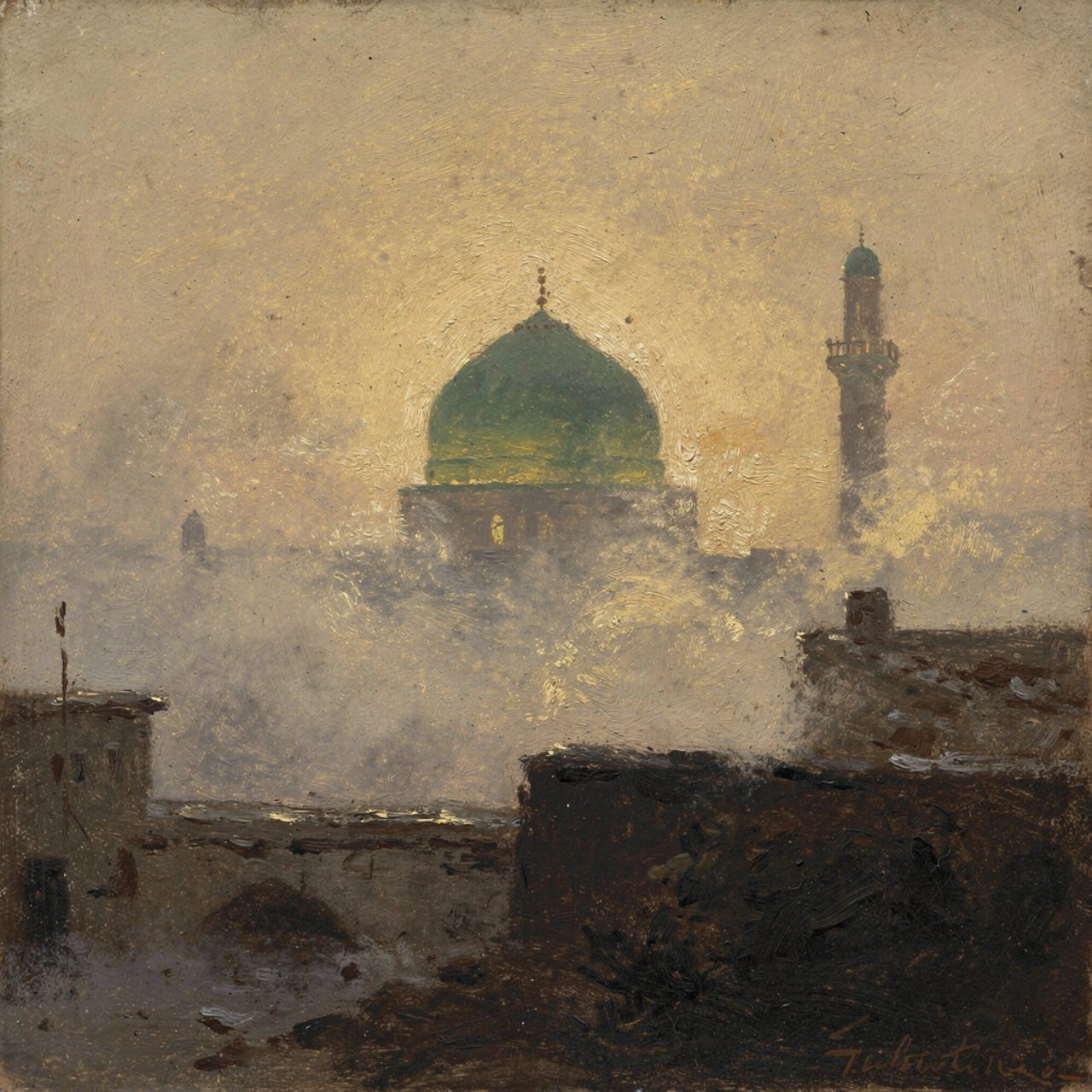
It was rush hour, and traffic would have added an extra 30–45 minutes to my commute, so I went to Qamaria to get some work done. I was in my own world—no kufi, sleeves rolled, shirt unbuttoned, sitting in one of the lounge chairs, AirPods in my ears, reading a book as I waited for Claude to finish processing. So when a sister gave Salams and asked if she could ask me a few questions, it caught me off guard.
“Of course! Please have a seat,” I responded, taking out my AirPods and closing my laptop.
Her questions flowed out, one after another. These were not superficial questions. They came rapidly, the way someone asks when they’ve been holding them for a long time, waiting for an opportunity to find answers. The last of which was the most profound to me: “If you were to give just one piece of advice on how someone could get closer to Allah, what would it be?”
Just a few weeks ago someone asked me the same question, so, Al-Humdulillah, I had spent some time reflecting on it. Both times my answer was the same: if I were to prescribe one spiritual panacea, or Ozempic, it would be Salawat on the Prophet ﷺ.
The Transactional Trap
There is nothing inherently wrong with being transactional. Something in us, at the most basic level, is built to look after its own wellbeing—to weigh effort against outcome, to ask whether a thing is worth what it costs. This is not a flaw in our design but a feature of it. We were not made as angels, fashioned out of obedience alone; we were made with appetites and aversions, with a stake in our own survival, and the calculation that follows from that stake is not in itself a sin.
Allah Himself does not disdain to speak to this part of us. He frames the reward of the believer in the language of commerce—a tijārah (trade) that will deliver us from a painful punishment,1 a purchase in which He has taken the lives and the wealth of the believers and given them the Garden in return.2 The whole architecture of ajr (reward) measured against deed speaks fluently in the grammar of exchange. If the transactional instinct were corrupt at its root, the revelation would not reach for it so readily, nor so often.
The tradition even ranks it. Jaʿfar al-Ṣādiq is reported to have said that worship is of three kinds: the worship of those who serve out of fear, and that is the worship of slaves; the worship of those who serve seeking reward, and that is the worship of hirelings; and the worship of those who serve out of love, and that is the worship of the free—and that is the most excellent of the three.3 Notice that the merchant’s worship is not cast out. It is real worship, and Allah honors it with real reward. But it is named for what it is: a lower door, the way into the house and not the room one finally lives in. The transactional posture is where nearly all of us begin. The error is not in entering there. The error is in mistaking the entryway for the dwelling, in furnishing a whole life of worship in the front hall and then wondering why it never quite feels like home.
So the problem was never the transaction. The problem is what happens when the transaction becomes the only language we know.
It is an instrument, and like any instrument it is suited to some work and ruinous for the rest. We have learned to carry it everywhere—to weigh and tally and audit by reflex, to ask of nearly everything we touch what it is getting us. In the world of work and survival, where the question was forged, it serves us. The trouble is that it does not stay where it is useful. It follows us home, into the rooms of our lives that were never built to answer it.
It has reshaped the way we love. Courtship has become a kind of marketplace—a scroll of candidates each weighed against the next, a running calculation of what a person offers set against what they are likely to cost. Friendship is increasingly kept like an account: who reached out last, whose turn it is, who has drawn more from the balance than they have returned. We have learned to call this self-respect. Beneath the reasonableness, something has quietly gone cold, because a bond that is perpetually audited is a bond already half-withdrawn.
And then, without ever marking the moment it happened, we carry that same ledger into our standing with Allah. The deeds become deposits. We pray and some part of us waits for the balance to rise; we fast, we give, we show up, and the running total is kept somewhere in the back of the mind, ready to be consulted the moment we feel shortchanged. Duʿāʾ (supplication) takes the shape of a transaction—the right words in the right number, submitted in the expectation that what we asked for will be released to us. And when it is not, when the hardship sits exactly where it has been sitting and our words seem to dissolve somewhere short of the ceiling, the logic delivers its verdict, and the verdict sounds like grievance. We did what we were supposed to do. So where is the thing we are owed.
That word is the whole problem. Owed. It is the language of a creditor, and the creditor is never at peace no matter how much he deposits. He is always counting, always waiting on the return, always poised to withdraw the moment the returns thin out—mistaking the keeping of an account for the building of a bond, and then unable to understand why he feels so far from the One he has given so much to. (I have written elsewhere, in “It’s not my money,” about this quiet arithmetic of what others can return to us, and the longing to be free of it.) The ledger was supposed to produce closeness. It produces only a more careful ledger.
But this is not how love has ever worked. We do not love our children for the favorable balance they return; by any honest accounting they run a permanent deficit, and we love them without once consulting it. We do not arrive at nearness to a friend by tallying the favors that have passed in either direction. Love does not come out even, and was never meant to. It runs on a logic entirely its own—and we have been carrying the wrong instrument into the one relationship that matters more than all the rest.
What Closeness Is Made Of
So what is that logic, if it is not the ledger’s?
Think of the people we are actually close to—not the ones we owe and not the ones who owe us, but the ones whose names sit warm in the chest when they come to mind. The closeness was not built by an exchange of favors. We did not arrive at it by keeping the columns even. It was built by something quieter and far less efficient: attention paid without expecting a receipt, concern that asked for nothing back, a willingness to be inconvenienced for them that we never thought to count. The closest bonds are precisely the ones where the accounting has stopped—where we have given up tracking who is ahead, because the question itself has become absurd.
And there is one mark of love that almost no one recognizes, because it costs nothing and announces nothing: the beloved stays on the mind. They are there when no transaction requires them to be. We think of them in the ordinary middle of the day, when they have asked for nothing and offered nothing, when there is no exchange in motion at all. Some remark they made comes back to us. We find ourselves wondering how their morning went. The remembering is not labor and it is not strategy—it is simply where the attention goes when it is left to itself. This is the truest evidence of love, more honest than any favor, because a favor can be performed without feeling and remembrance cannot. We do not have to be reminded to remember the ones we love. They live in our attention rent-free, and we would not evict them if we could.
First we come to know someone—not their facts but their life, the way they carry themselves through the world, what they have suffered and what they have chosen. What we know kindles what we feel: knowing ripens into love—the love that keeps no receipt, that carries them into the middle of an ordinary day unbidden, that lets itself be inconvenienced without counting the cost. And love, when it is real, refuses to remain a feeling. It moves us. It reorders how we live and bends us toward the one we love until we begin, slowly, to resemble them. This is the shape of every closeness we have ever had, and it is the only shape that closeness with Allah was ever going to take.
The One We Cannot Reach
That movement has a first step, and the first step is where everything can stall. It begins with knowing—and we have never known anyone the way we are now being asked to know Him. Everyone we have ever loved came to us with a face we could study, a voice we could recognize in another room, a life we could learn by heart and a hand we would one day have to release. Knowing always had something to hold on to. Then we are asked to love the One who has no likeness at all.
This is the difficulty underneath a great deal of worship that has gone dry, and it is rarely named because it feels close to blasphemy to say it. We believe in Allah completely and still cannot find the handle by which to hold Him near. He is beyond image, beyond form, beyond anything the imagination can assemble and keep. The very perfection that makes Him worthy of worship is what makes Him feel far: He resembles nothing, so the mind has nothing to rest on. Love wants somewhere to land, and tawḥīd gives us the One above all places to land.
And there is a second difficulty folded inside the first. Our love for one another is fed, in part, by being needed—we grow attached to the people who need us, and to the ones we cannot get through the week without. But Allah is al-Ghanī (the Independent, utterly free of need). He needs nothing from us. Nothing we bring adds to Him and nothing we withhold diminishes Him. So the ordinary engine of human affection, the sense of being necessary to someone, idles and finds no purchase. What do we offer to the One who lacks nothing? How do we draw close to the One who was already whole before we existed and will be whole long after?
This is not a crisis of belief. It is a crisis of intimacy inside belief—the prayer that is correct in every position and cold in every rakʿah, the dhikr (remembrance) that moves the tongue and leaves the heart exactly where it found it. There is an old counsel that runs: had you truly known Allah, you would love Him; and had you loved Him, you would obey Him. The chain is exact—love follows knowing, obedience follows love—and every link of it hangs on the first. Which is just where we falter. It is not that we refuse to love, or refuse to obey. It is that we have never known Him the way knowing is meant to work, so the chain never catches. We were built to love what we can know, and we have been asked to love the One we can never fully comprehend. The question is not whether He is worthy of love. The question is how creatures like us, who need a face, were ever meant to give it to Him.
The answer is that He knew this about us before we knew it about ourselves. And knowing it, He gave us a face to turn toward.
Al-Ḥabīb: The One We Can Know
He did not give us an abstraction to contemplate. He gave us a human being to know—someone who ate and slept and grew tired, who was born and who died, who moved through an actual life with an actual body. Not a theory of mercy but a man who embodied it; not a doctrine of patience but a person you could have sat beside and watched be patient. Allah answered the difficulty of loving the Unseen by sending someone seen.
And the same law holds for him. What fails us with the Unseen is the first link—the knowing—and that is precisely the link the Prophet ﷺ restores, because he was one of us. We cannot picture the One beyond all likeness, but we can know a man who hungered and grieved and bled. The chain that could never catch when we reached for Allah directly catches at once with the human being He sent. And to obey Allah, it turns out, is simply to follow him.
The movement we traced between people, the scholars named outright when they turned to him. Qāḍī ʿIyāḍ (d. 544/1149) built the whole second part of Al-Shifāʾ on that very sequence: love of the Prophet ﷺ is not conjured out of nothing, nor commanded into being from the outside. It is bred by knowing him.4 Come to know his generosity, his character, the mercy that poured off of him toward people who had no claim on it, and love follows the way warmth follows a fire. And love, once it is real, does not sit still—it reaches for resemblance. Know him and you will love him; love him and you will want to live as he lived. The same three steps, now turned toward the most worthy subject a heart could take.
We already know that this is how the heart works, because we watch it happen with people we will never meet. A man can love an athlete he has never spoken to—can follow his seasons, ache over his losses, feel a strange personal pride in his triumphs—not because the athlete has done a single thing for him, but because he knows him: his story, his struggle, the years of unseen work behind the visible skill. Or consider a great-grandfather who died before we were born. A photograph of him will engender little; a face without a story is just a stranger’s face. But let someone tell us how he lived, what he sacrificed, the hardships he swallowed so that our lives could one day be possible, and something turns over in the chest. We find that we love a man we never met. Knowing did that. Not seeing—knowing.
So why would the Prophet ﷺ be any different? To love him, we have to move past the flat facts of him—the dates, the battles, the list of names—and actually know the texture of his life. And the texture is astonishingly human. He knew strain in his own household, discord serious enough that Abu Bakr, his closest friend and father-in-law, came in to help mediate. He knew grief as a parent in the most final way there is: he lived to bury his own children. He knew betrayal from his own blood—some of his fiercest enemies carried his own family name. He knew physical fear and physical pain, stood in the ranks of actual battle, and left the field wounded. He was not spared the ordinary weight of being a person. He carried all of it, every texture of a human life, and remained the embodiment of mercy through the whole of it.
That is a man the heart can actually reach. This is why he is al-Ḥabīb (the beloved)—not a title awarded from a distance but a relationship on offer. He is the mercy sent to all the worlds, and he is the door: the one who leads us out of the front hall of a religion we merely transact and into the room where Allah is actually known. We do not worship in the abstract; we follow a life. Everything we cannot picture about the One beyond likeness, we begin to approach through the one He sent to show us the way to Him.
And this is finally why we trouble ourselves to learn his love at all. My teachers used to say: we learn to love the Beloved so that we might learn to be beloved. Loving him is not the terminus—it is the path by which the ones who love him are drawn toward the One who sent him. For the promise is that if we love Allah and follow His Messenger, Allah will love us in return,5 and so every increase in our love of the Beloved is a step toward becoming beloved ourselves.
And we know what that love looked like in the ones who knew him best, because it was neither cool nor abstract—it rearranged the furniture of the self. Umar ibn al-Khattab once told him, “O Messenger of Allah, you are more beloved to me than everything—except my own self.” The Prophet ﷺ answered that his faith was not yet complete: not until I am more beloved to you than your own self. And Umar, a man not given to sentiment, turned it over and came back a moment later: “Now, by Allah, you are more beloved to me than my own self.” The Prophet ﷺ said, “Now, O Umar.”6 Notice what the exchange takes for granted—that love has a magnitude, that it can be set against the dearest thing a person owns, and that it can move, in the space of a breath, past even the self. This is not admiration keeping a polite distance. It is the kind of love that changes who sits at the center of a life.
And once we have come to know him like this, something shifts from doctrine into longing. We begin to want more than his intercession as a legal benefit. We want him. We want to be near him, to be counted among the ones he recognizes, to drink from his basin on the Day when every other thirst has failed. Knowing his life turns a distant reverence into an ache to be close. The only question left is how to keep him near now, in the ordinary middle of our days, while the distance between his time and ours is measured in centuries.
Salawat: Love in Motion
Start with something we would rather not examine. Almost everything we have was never owed to us. Our health, our wealth, our safety, the roof and the routine and the ordinary security we build our days on—none of it was our entitlement. And beyond even that generosity, Allah forbears with us: were He to seize us for what we have actually earned, the reckoning would already be here. Instead He holds it back. “And your Lord is the Forgiving, full of Mercy; were He to take them to task for what they have earned, He would have hastened the punishment for them.”7 The honest response to being carried like this is not accounting. It is love.
And love, when it is real, changes how we live. We know this from the parts of our lives that have nothing to do with religion. We drag ourselves to the gym and welcome the ache because we love the body we are working toward more than we love the comfort we are giving up. We hold ourselves to a caloric deficit, skip the meal out, save instead of spend, put money away where we cannot easily reach it—accepting a hundred small discomforts now because we love a future we can already picture. Behavioral change always costs something. We pay it, and pay it gladly, whenever we love the end more than we love our present ease. That is what changing our behavior actually is: an act of love, love in motion, love willing to be inconvenienced.
So the question asks itself. Why do we extend that willingness to our bodies and our bank accounts, and withhold it from Allah? Why is the discomfort worth it for the physique and the portfolio, but not for the One to whom we owe the very capacity to want anything at all?
If behavioral change is an endeavor of love, then the work is to grow the love—and the easiest place to begin, the lowest possible cost with the highest possible yield, is to send Salawat upon the Prophet ﷺ. It asks almost nothing of us. It requires no wuḍūʾ (ablution), no fixed time, no particular place. We can say it walking to the car, waiting for a page to load, lying awake at two in the morning. There is no lighter act in all of the religion, and few that carry more.
A question usually follows close behind: which wording, which formula? There are many. Some are a single breath long; others run to several lines, gathering in his family and his companions, ornamented with honorifics. And the honest answer is that it matters far less than we tend to fear. To hunt for the optimal ṣīgha (formula)—the most potent arrangement of words, the one that returns the most—is only the counting habit slipping back in through a side door. What is asked is sincerity, and after sincerity, beauty: the more heartfelt the blessing and the more eloquent, the more it befits the one it is meant for. But the plainest sincere salutation reaches him. The one I return to most is simple:
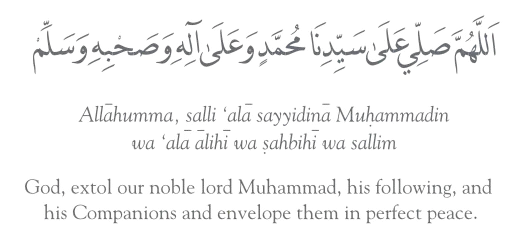
Say that, or say less, or say more. The words are only the vessel. What moves through them is the love.
And here is what lifts it entirely out of the ledger. When we send Salawat, we are not making a deposit and waiting for a return. We are stepping into something Allah and His angels are already doing. “Indeed, Allah and His angels send blessings upon the Prophet. O you who believe, send blessings upon him and greet him with peace.”8 There is no other act of worship framed quite like this—where the command is not “do this and be rewarded” but “join what is already underway.” Al-Ghanī, who needs nothing, honors His Messenger; the angels honor him; and we are invited into the same motion. It is not a transaction. It is participation in a love that was flowing long before we arrived.
What are we actually doing when we say it? More than moving the tongue. And here the whole movement answers an obvious objection—that knowing him was all very well for the Companions who sat with him, but he has been gone fourteen centuries and we will never see his face. Salawat is how the knowing is kept alive across that distance. It is layered dhikr: the words themselves, and the remembrance of him ﷺ that the words carry, and the renewal, each time, of the intention to live as he lived. It is remembrance made deliberate—we keep him on our minds on purpose until keeping him there becomes second nature, the knowing feeds the love, and the love begins, slowly, to reshape how we live. The whole of it, running on a single sentence that can be said anywhere.
The Prophet ﷺ told us plainly where this leads. A person is with the one they love.9 Nearness on the Day of Judgment is not assigned by the size of the ledger; it tracks love. And love is not a fixed quantity—it grows or it fades, it is always in motion. This is the whole reason to increase our Salawat. We do not multiply it to multiply credit, stacking deposits toward a balance. We multiply it because nearness follows love, and love is alive, and every remembrance is a small feeding of it. The ledger is static; this is not. The one keeps a colder and colder account; the other grows a warmer and warmer bond.
There was a companion who understood this before the rest of us. Ubayy ibn Kaʿb asked the Prophet ﷺ how much of his duʿāʾ he should devote to sending blessings upon him. Should it be a quarter? A half? Two-thirds? Each time the answer was the same: as much as you wish, and more would be better for you. Finally he said he would give all of it—his entire duʿāʾ—to Salawat. And the Prophet ﷺ told him that then his concerns would be sufficed and his sins forgiven.10 There it is, from his own blessed mouth: the one thing, given to a man who wanted the one thing—the lightest act in the religion, wearing the disguise of a shortcut.
From Bank Account to Relationship
This is the whole movement of the thing—out of the front hall and into the room where we actually live. The account never made us feel close; it only made us better accountants. But a heart that has begun to love does not keep a balance, because the question of who is ahead has stopped making sense. What replaces the ledger is not a bigger ledger. It is a relationship: emotional depth, real attachment, a nearness that no longer depends on the returns coming in on schedule.
And that is what carries a person through. When our standing with Allah is a transaction, every unanswered duʿāʾ is a breach of contract, every hardship a debt unpaid, and the faith cracks along exactly those lines. But when it is a relationship built on love, the hardship does not sever anything, because love was never contingent on the terms. We persevere—not because the ledger finally balanced, but because we are near Someone we trust, and we have come to see everything through the lens of that nearness. This is the station of the ones the Quran describes as having nothing to fear and no cause for grief: “Behold, the friends of Allah—no fear shall come upon them, nor shall they grieve.”11 They are not fearless because life stopped wounding them. They are fearless because they stopped viewing their lives through the ledger and started viewing them through the One they love.
None of us arrives there in an afternoon. But there is a first step, and it is the lightest step in the whole religion, and it was the only answer I could give a sister in a coffee shop who wanted to know the one thing. If we want to be close to Allah, we begin by falling in love with the one He sent as the door to Himself. And the way we begin to love someone is the way we always have—by keeping them on the mind until we cannot stop, until the remembrance moves on its own.
Send Salawat upon the Prophet ﷺ. It is the panacea I keep coming back to. It has the look of the shortcut we are all chasing, and it truly is the single lever worth pulling—but it does not work by sparing us the road. It works by setting us on the road in love, until the walking no longer feels like a cost.
اللَّهُمَّ صَلِّ عَلَى مُحَمَّدٍ وَآلِ مُحَمَّدٍ فِي الأَوَّلِينَ
وَصَلِّ عَلَى مُحَمَّدٍ وَآلِ مُحَمَّدٍ فِي الآخِرِينَ
وَصَلِّ عَلَى مُحَمَّدٍ وَآلِ مُحَمَّدٍ فِي الْمَلَإِ الأَعْلَى إِلى يَوْمِ الدِين
Ultimately, with Allah is all success.
Quran 61:10.
Quran 9:111.
Attributed to Jaʿfar al-Ṣādiq (d. 148/765), cited in The Study Quran: A New Translation and Commentary, ed. Seyyed Hossein Nasr et al. (New York: HarperOne, 2015), commentary on Q 1:5, 64 (citing al-Ṭabrisī, Majmaʿ al-Bayān).
Qāḍī ʿIyāḍ (d. 544/1149), Al-Shifāʾ bi-Taʿrīf Ḥuqūq al-Muṣṭafā, Part Two, “The Necessity of Loving Him ﷺ,” section on the signs of love (ʿalāmat al-maḥabba): the one truthful in his love is he upon whom its sign appears, and the first of these is emulating him (al-iqtidāʾ bihi)—employing his sunna, following his words and deeds, complying with his commands, and shunning his prohibitions. Verified against Sharḥ al-Shifāʾ (Beirut: Dār al-Kutub al-ʿIlmiyya), 2:45. That knowing him engenders the love which obligates this following is the architecture of the work itself: Part One establishes his qualities, Part Two the love and emulation they require.
Quran 3:31: “Say, if you love Allah, then follow me, and Allah will love you.”
Quran 18:58.
Quran 33:56.
Quran 10:62.
I am a Christian, and one day I shall die a Christian. But I see the wisdom in this and I shall share it with my sons, so that they shall make their own decision.
This was truly profound masha’Allah, بارك الله فيك ونفع بعلمك 🤲🏼