

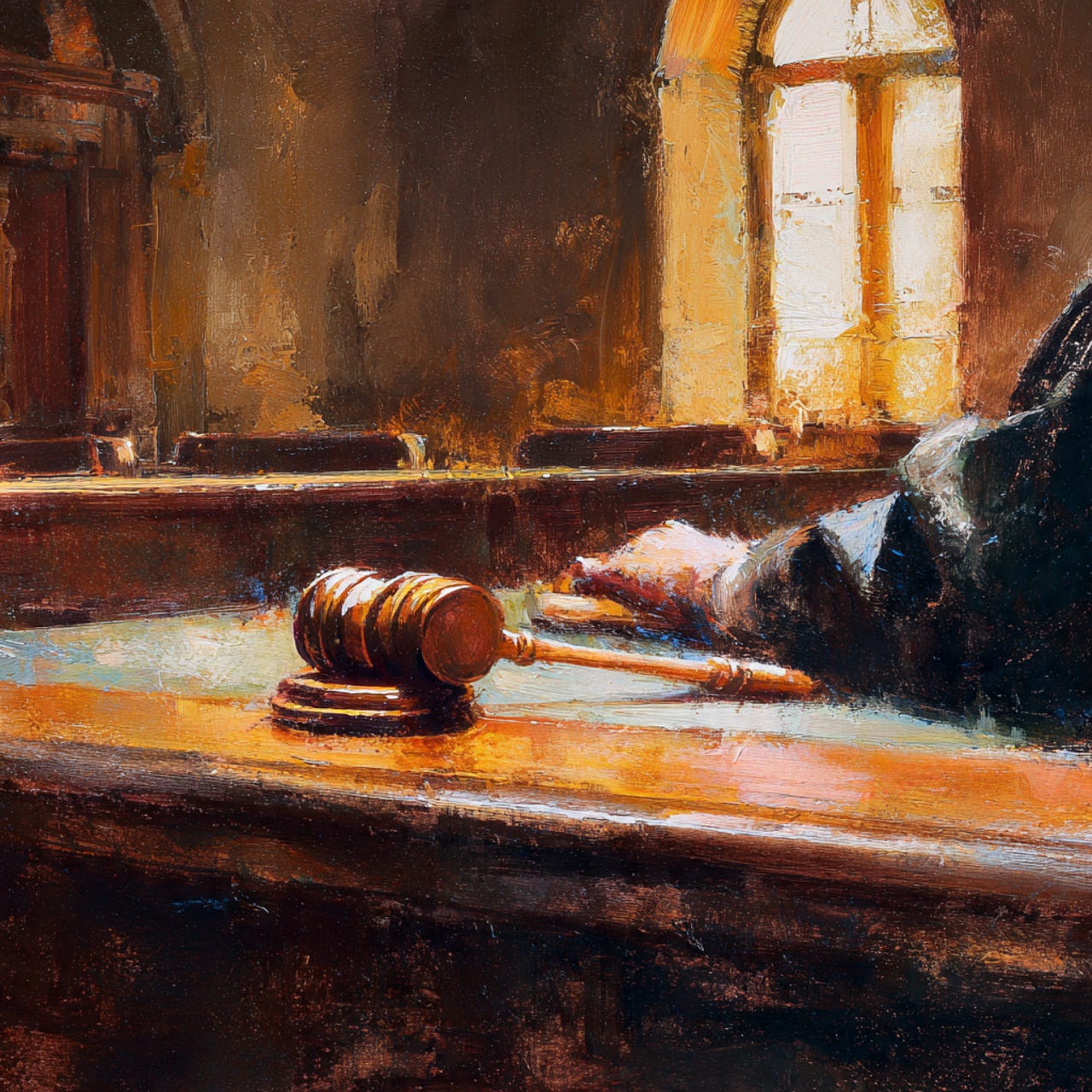
There is a quality to the clarity that arrives after anger cools. Not resolution—nothing has been resolved. The injustice still stands, doing what it was designed to do. But the heat has settled into something sharper, and the shape of the thing becomes visible in a way it could not when everything was burning.
I have written before about what that kind of burning feels like—the specific quality of righteous indignation, and the spiritual discipline of carrying it without being consumed by it. I was inside the fire then. I could not see what it was illuminating until it had done its work. What it showed was not just that a wrong was being done, but how. The particular architecture of it. What it also illuminated was that my own capacity for that kind of arrangement was not zero. The move I am about to describe is not one I am only seeing from outside.
What follows is an attempt to name that architecture. Not to settle anything—the settlement is not mine to make. But because the next generation is watching, in this gathering and in others like it across the country, and they deserve language for what they are seeing before they are put in positions where they must act on it themselves.
The hadith is from Sunan Abi Dawud, narrated by Umm Salama, may Allah be pleased with her. The Prophet ﷺ said:
“I am only a human being, and you bring your disputes to me, some perhaps being more eloquent in their plea than others, so that I give judgement on their behalf according to what I hear from them. Therefore, whatever I decide for anyone which by right belongs to his brother, he must not take anything, for I am granting him only a portion of Hell.”1
What is striking about this hadith is what it refuses to do. It does not comfort. It does not promise the truth will prevail in the courtroom. It does not assure the wronged party that the system will see through the deception. It tells them plainly that it will not—and then it addresses the person holding the unearned verdict.
Al-Khattabi (d. 388 AH/998 CE), the first authoritative classical commentator on Sunan Abi Dawud, drew out the word at the center: alhan. The form, he explained, names not honesty but astuteness—shrewdness and acuity in the arrangement of one’s case.2 Not more honest. Not louder. More skilled in composition. Abu ʿUbayd al-Qasim ibn Sallam (d. 224 AH/838 CE), the early lexicographer, confirmed this from the oldest layer of the tradition: alhan bi-hujjatihi means “more astute in it and more skilled in presenting it.”3
This is the hadith’s precision. The problem is not fabrication—the tradition addresses lying separately and more simply. The problem is arrangement. Every word can be technically true. Every fact can be accurately stated. The corruption is in the intention behind the sequencing: what to emphasize, what to leave in silence, what the listener will be led to conclude. The arrangement is shaped, consciously or not, to produce a verdict its architect would recognize, on honest reflection, as unjust.
Al-Khattabi then named the split that this kind of arrangement produces: the ruling, he wrote, “stands in the apparent legal realm—but as for the interior moral realm and the judgment of the Hereafter, it does not stand.”4 The system renders a verdict on the surface. The moral reality sits untouched underneath. The verdict and the truth now occupy separate rooms. The winner holds the key to both.
Ibn Hajar al-ʿAsqalani (d. 852 AH/1449 CE) named those rooms precisely in his Fath al-Bari: “The upshot is that there are two realms here: the first is the path of legal judgment, and the second is what the opponent conceals in his interior, which only Allah sees.”5 The judge cannot enter the second room. The community cannot. The ruling cannot reach it. Only the person standing with the verdict knows which room they are standing in—and what they are carrying.
The Prophet ﷺ called what they carry qitʿatan min al-nar—a piece of Fire. Not guilt. Not shame. Not a metaphor for consequence. Something physical. Carried. The Sunan Ibn Majah narration adds the temporal dimension: “a piece of fire that is given to him which he will bring forth on the Day of Resurrection.”6 The taking is not a future risk. It is a present acquisition. The piece of Fire is gathered at the moment of taking, carried forward from that moment, and brought out at the accounting. The ruling does not sanctify what was taken. It never did.
The word alhan names a wrong that is harder to see than lying precisely because it wears the face of legitimate advocacy.
The alhan person does not necessarily fabricate. They arrange. The sympathetic detail leads. The complicating fact arrives late, buried, or not at all. The overall structure of what is said produces a conclusion the speaker knows the listener will draw—and knows is false. This is where the wrong lives: not in any individual word but in the intention behind their assembly. The words are true. The picture they compose is not.
The dividing line is niyyah (intention). The same speech, assembled for justice rather than winning, is a different act. The Prophet ﷺ anchored the entire tradition of Islamic ethics in this: “Actions are by intentions, and each person shall have what they intended.”7 Justice and winning can produce identical sentences. Only the speaker knows which one they are giving. The system hears the words. Only the speaker hears the intention behind them. And only Allah sees both.
The root condition that enables the alhan move—that makes a person willing to arrange truth in service of winning—is kibr (arrogance). Not the theatrical kind. Al-Ghazali (d. 505 AH/1111 CE) was precise about this in his Kitab dhamm al-kibr wa-l-ʿujb (Condemnation of Pride and Self-Admiration): in its most dangerous form, kibr is the refusal to let truth be larger than one’s own claim.8 The humble person arranges themselves around truth even when truth costs them the verdict. The arrogant person arranges truth around themselves and takes what the ruling offers.
What the tradition names as the antidote is tawaduʼ (humility)—which at this level of cost means something precise. Not modesty. Not deference. The willingness to surrender a legitimate-looking claim because the interior knows it is not clean. This is a demanding spiritual act. It requires what it has always required: the courage to absorb a real loss—social, financial, reputational—rather than take what arrangement has won.
Al-Muhasibi (d. 243 AH/857 CE), the founder of the muhasabah (self-accounting) tradition, took up the Quranic typology of the soul and made it the center of an interior practice. The ego-driven self the Qurʼan names al-nafs al-ammara—the commanding soul that does not announce itself, that borrows the language of sincerity, that generates genuine feeling to insulate itself from honest reckoning. The movement toward justice requires passing through al-nafs al-lawwama—the self-blaming soul—which is exactly the station the alhan move is designed to avoid.9 The arrangement is, among other things, a way of never arriving at self-blame.
The wrong I have been describing does not only harm the person who absorbs it. It teaches the community what the rules actually are—and the lesson holds against whatever anyone preaches against it.
Communities learn from what they tolerate. Every unjust verdict that stands and goes unnamed becomes pedagogy. The next generation watching learns, without being told, that the eloquent win. That arrangement is rewarded. That the moral interior of a claim is invisible to the process, and therefore irrelevant to its outcome. They learn this not from doctrine but from observation.
The ego that operates inside community is harder to name than ego in isolation because it wears the right clothes. It shows up. It serves. It speaks the language of the collective. It sustains years of genuine contribution while quietly arranging every situation in its own favor. The alhan person is frequently not a villain—they are a recognized, committed community member. That is precisely what makes the corruption so difficult to address. The community’s instinct to protect its standing, to avoid fitna (discord), to assume good intentions in those it has trusted, becomes the mechanism that insulates the wrong from accountability.
I have written elsewhere about how the American masjid adopted operating models that measure success by what can be counted, making invisible what cannot be—connectedness, formation, whether people are actually being drawn closer to Allah and to one another. The alhan problem thrives in precisely those conditions. When the metrics are numerical, the eloquent win by default. When justice cannot be counted, it disappears from the conversation.
The adab (decorum) that healthy community requires—the posture of asking what this space deserves from me—is exactly what kibr wearing the face of service corrodes first. The shift from what do I owe? to what can I take? rarely announces itself. It arrives in small accommodations, each individually defensible, until the posture has hardened into something that no longer recognizes itself.
When silence and the fitna defense no longer hold, the institutional language shifts. Maslaha (public interest) enters the conversation—the outcome must stand, the greater good requires the matter to be settled. Maslaha is a legitimate and necessary category in Islamic legal reasoning, with its own classical literature and its own conditions. What I have witnessed is not its use. It is its inversion. Al-Shatibi (d. 790 AH/1388 CE) opens his treatment of the objectives of Sharia with a sentence whose logic an inverted maslaha cannot survive: the purpose of Sharia is to free the legally responsible person from the pull of his ego, so that he may be a servant of Allah by choice as he is by necessity.10 On that framework, a maslaha claim that originates in the protection of one’s own interests is not simply misapplied—by Shatibian logic, it has named its opposite. What confirms the inversion most clearly is the willingness to lie. Maslaha is a tool for honest reasoning under genuine uncertainty; a category built for that kind of reasoning cannot survive deliberate concealment as its method of defense. The willingness to lie inside such an argument is the proof that what is being defended is not maslaha but hawa (ego, desire) wearing the grammar of jurisprudence.11 And as Ibn ʿAbd al-Salam (d. 660 AH/1262 CE) named in Qawaʼid al-Ahkam fi Masalih al-Anam (The Rules of Islamic Law Regarding the Welfare of Humanity), the science is anchored in the welfare of people not in the protection of institutions.12 When the institution’s continued standing requires harming those it exists to serve, the maslaha argument has not been misapplied. It has been used against itself.
The formational consequence is what concerns me most. The next generation watching this is not only witnessing an injustice. They are being shaped by it. The community does not only produce decisions—it produces people shaped by whatever it decides and tolerates. What they observe about how disputes resolve becomes the frame through which they will one day make their own decisions. Some of what I am setting down here is, in part, an attempt to interrupt that inheritance.
The first is about the interior. The alhan move does not always arrive with full consciousness of what it is. Al-Muhasibi spent his life on this problem: the nafs al-ammara does not announce itself. It borrows the language of sincerity. It produces genuine feeling—genuine offense, genuine conviction, genuine sense of being wronged—that makes the arrangement feel like truth-telling from the inside. The practice that breaks through is muhasabah, but Al-Muhasibi himself warned that outward piety can mask hidden ego: that even rigorous self-examination can become another performance if the will behind it is not surrendered to Allah. The question that matters is not whether one is doing this. It is what practice makes the answer to that question honest rather than self-serving—and that practice has to be built before the dispute, not during it, because during it there is too much at stake and too much available rationalization.
The second is about relationships. The tradition’s answer to the interior problem is suhba (companionship)—people with enough proximity and enough freedom to tell you when your account of events is suspiciously favorable to yourself. Not admirers. Not people who depend on you. People who will cost you something by being honest, and do it anyway, because the relationship is built on something more than convenience. Ibn ʿAtaʼillah al-Iskandari (d. 709 AH/1309 CE) named the condition that makes such suhba possible: “Among the signs of success at the end is the turning to God at the beginning.”13 The suhba that checks you is suhba oriented toward Allah rather than toward one another’s comfort. Most people in community leadership do not have this. They have people who defer to them. Building accountability means deliberately cultivating relationships structurally positioned to check you—before the dispute arrives, not during it.
The third is about authorization. When the alhan person holds authority—over a board, over a process, over the community itself—speaking truth to that authority is not insubordination. The Prophet ﷺ named it among the highest forms of jihad (struggle in Allah’s cause): “The best fighting in the path of Allah is a word of justice to an oppressive ruler.”14 Communities regularly deploy other hadith to suppress exactly this speech—calling honest witness fitna, calling accountability disrespect for leadership. That inversion of the tradition must be named for what it is: the tradition being used against its own purposes. The speech is authorized. The community’s discomfort with it does not change that.
What that speech actually sounds like is the harder question. It is not denunciation. It is not the satisfaction of being right. It names the thing—specifically, with evidence one is willing to stand behind—and stops there. It does not bid for an audience and it does not require the speaker’s vindication to count as faithfully said. The suhba described above is what protects this speech from sliding into self-righteousness, because the same companions who authorized the speech are also positioned to ask the speaker afterward what part of the witness was for Allah and what part was for the speaker’s own standing. Without that second question, even authorized speech can become its own alhan. The tradition’s authorization extends to the witness; it does not authorize the satisfaction.
The ruling does not determine the moral reality. The Prophet ﷺ already said so.
The judge who ruled on what he heard is absolved—he did what the role requires, and the weight does not rest with him. The person who wins what is not theirs is carrying fire. The person who loses what was rightfully theirs is not carrying anything they were not already holding. The verdict changed the legal situation. It did not change the truth. Those are different rooms, and the One who knows which room everyone was standing in has not yet rendered His accounting.
This is cold comfort and genuine comfort simultaneously. The loss is real. The wrong stands. The freshness of it is not yet integrated, and pretending otherwise would be its own kind of arrangement. What the tradition is saying is that the wrong standing does not mean the truth has been overturned—only that the room where truth lives has not yet been entered by the final accounting. That accounting is not optional, and it is not distant in the way that makes it easy to set aside. It is the reality into which everything done in this life is being gathered, moment by moment, verdict by verdict, piece by piece.
Hope in this situation is not optimism. Optimism is contingent on the evidence; hope acts on a vision despite it. What the wronged person needs in this moment is hope in the second sense—the theological conviction that the outcome of this process is not the final word. Allah, Al-ʿAleem al-Khabir (the All-Knowing, the All-Aware), is the One who sees the second room. The Quran is unequivocal: “And We shall set up scales of justice for the Day of Resurrection, so that not a soul will be dealt with unjustly in the least.”15 What is unseen here will be seen there. His mercy and His justice are not in competition. They both arrive.
There is a space between knowing what is true and being able to act on it—the liminal territory of sitting with righteous indignation and waiting for the means of address to become available. That space is not wasted. It is where clarity is refined. It is where the soul is tested not by what it suffers but by what it chooses to become in the suffering. And it is where the next generation is watching, learning the difference between justice as a posture and justice as a performance—learning it from whoever is willing to model it honestly.

This was written for the ones watching.
Not for the person holding the verdict—that accounting is already underway, and the Prophet ﷺ has spoken to it with more precision than any essay can. Not for the judge, who bears the weight of his office and its limitations. For the young men and women sitting in the back of rooms where decisions are being made, watching how disputes resolve, learning in real time what the rules actually are.
When they sit in those rooms themselves—and they will—the tradition has already given them what they need. The Prophet ﷺ named the mechanism. Al-Khattabi drew out the word. Ibn Hajar named the two rooms. Al-Muhasibi mapped the interior. Al-Ghazali named the root condition. Al-Shatibi guarded the language of maslaha from the people who would invert it. The hadith on speaking truth to power named the authorization.
What remains is the choice. It will require what it has always required: the humility to let truth be larger than one’s claim, the honesty to name what one knows, and the courage to absorb the cost of both.
To the ones watching: do not let what you have seen drive you out of khidmah (service). The temptation will arrive, and it will sound like wisdom. It will tell you that institutional life is corrupting by nature, that the clean posture is distance, that the people who stay are the ones willing to play the game. That voice is the second injury of what you witnessed. The first injury was the wrong itself. The second is the conclusion that the only response is to leave the rooms to the people who produced it.
Stay. Stay as agents of islah (rectification). The communities that need you most are the communities that broke your trust. The rooms that taught you what was wrong are the rooms that need someone in them who knows. The tradition did not survive fourteen centuries because each generation walked away from corrupted institutions. It survived because each generation produced people who stayed and rebuilt them from inside, knowing the cost, paying it deliberately. That is what is being asked of you. It is not a clean inheritance. It is a real one. And it is yours.
The ruling is not the last word. It never was.
Ultimately, with Allah is all success.
Abū Sulaymān Ḥamd ibn Muḥammad al-Khaṭṭābī, Maʿālim al-Sunan: Sharḥ Sunan Abī Dāwūd, ed. Muḥammad Rāghib al-Ṭabbākh (Aleppo: al-Maṭbaʿa al-ʿIlmiyya, 1351 AH/1932), commentary on hadith no. 3583, https://shamela.ws/book/1442.
Abū ʿUbayd al-Qāsim ibn Sallām, quoted in Ibn ʿAbd al-Barr, al-Tamhīd li-mā fī al-Muwaṭṭaʼ min al-Maʿānī wa al-Asānīd, vol. 22, in commentary on the hadith of Umm Salama. The gloss is sometimes loosely attributed to Abū ʿUbayda Maʿmar ibn al-Muthannā, but the chain in al-Tamhīd runs through Abū ʿUbayd.
al-Khaṭṭābī, Maʿālim al-Sunan, on hadith no. 3583.
Ibn Ḥajar al-ʿAsqalānī, Fatḥ al-Bārī Sharḥ Ṣaḥīḥ al-Bukhārī (Cairo: al-Maṭbaʿa al-Salafiyya, n.d.), 13:173, commentary on al-Bukhārī, Ṣaḥīḥ, no. 7169.
Abū Ḥāmid Muḥammad al-Ghazālī, Kitāb dhamm al-kibr wa-l-ʿujb, book 29 of Iḥyāʼ ʿulūm al-dīn; English translation: Al-Ghazālī on the Condemnation of Pride and Self-Admiration, trans. Mohammed Rustom (Cambridge: Islamic Texts Society, 2018).
The three stages of the nafs—al-nafs al-ammāra (Qurʼān 12:53), al-nafs al-lawwāma (Qurʼān 75:2), and al-nafs al-muṭmaʼinna (Qurʼān 89:27)—are Qurʼānic. Al-Ḥārith ibn Asad al-Muḥāsibī, in Kitāb al-Riʿāya li-Ḥuqūq Allāh, made this typology the working ground of an interior practice he called ʿilm al-muḥāsaba.
Abū Isḥāq Ibrāhīm ibn Mūsā al-Shāṭibī, al-Muwāfaqāt fī Uṣūl al-Sharīʿa, ed. ʿAbd Allāh Darrāz (Beirut: Dār al-Maʿrifa, n.d.), 2:289.
Abū Ḥāmid Muḥammad al-Ghazālī, al-Mustaṣfā min ʿilm al-uṣūl (Beirut: Dār al-Kutub al-ʿIlmiyya, 1413 AH/1993), 275, on the strict conditions for maṣlaḥa mursala and the prohibition of ḥukm bi-l-hawā (judgment by pure whim).
ʿIzz al-Dīn Ibn ʿAbd al-Salām, Qawāʿid al-aḥkām fī maṣāliḥ al-anām (Beirut: Dār al-Kutub al-ʿIlmiyya, 1999).
Ibn ʿAṭāʼ Allāh al-Iskandarī, Ibn ʿAṭāʼillāh’s Sufi Aphorisms (Kitāb al-Ḥikam), trans. Victor Danner (Leiden: E. J. Brill, 1973), aphorism 26; available at the Matheson Trust, https://www.themathesontrust.org/library/al-hikam-aphorisms.
Qurʼān 21:47.